Thursday, October 31, 2019

harriet


Surprisingly, or not surprisingly, there has been no major film about Harriet Tubman until now; Kasi Lemmons' (Eve's Bayou) new film comes riddled with great anticipation and expectations. For those looking for a complex portrait of this symbolic pillar of American history, whose life is still opaque and underappreciated by many (even to get her on the twenty dollar bill in recent times has been met with ridiculous opposition), will not be completely fulfilled. However, the movie is slick and involving--thanks to its brisk pace, handsome photography (by John Toll, who established the look of the historical epic of the mid-1990s with his Oscar-winning work on both Legends of the Fall and Braveheart), and a graceful, centerpiece turn from Cynthia Erivo.


Harriet mainly focuses upon Tubman's first escape from slavery and her subsequent trips back to lead over seventy slaves to freedom. She is often hit with bouts of spiritual "visions" which guide her throughout her courageous quests. These visions are lensed with a bluish tint--a chaotic, quick-flitted rendering of abuse in chattel. I was reminded of the snowy, bird-swept prophetic visions in well water in Anthony Minghella's Cold Mountain--a subversive nod, if it is indeed a reference here. What makes Lemmons' film compelling (and somewhat subversive) is that it seems molded after white male hero historical action dramas that have been churned out from the Hollywood machine for decades. The captivating Erivo, defies the odds pitted against her--including slave owner Gideon (Joe Alwyn)-- and rises to occasion. Despite the movie's rousing surface narrative, there is also the complexity of her life in Philadelphia with abolitionist William Still (Leslie Odom Jr.) and a stinging undercurrent in her friendship with her elegant, born-free house mother Marie (Janelle Monáe).
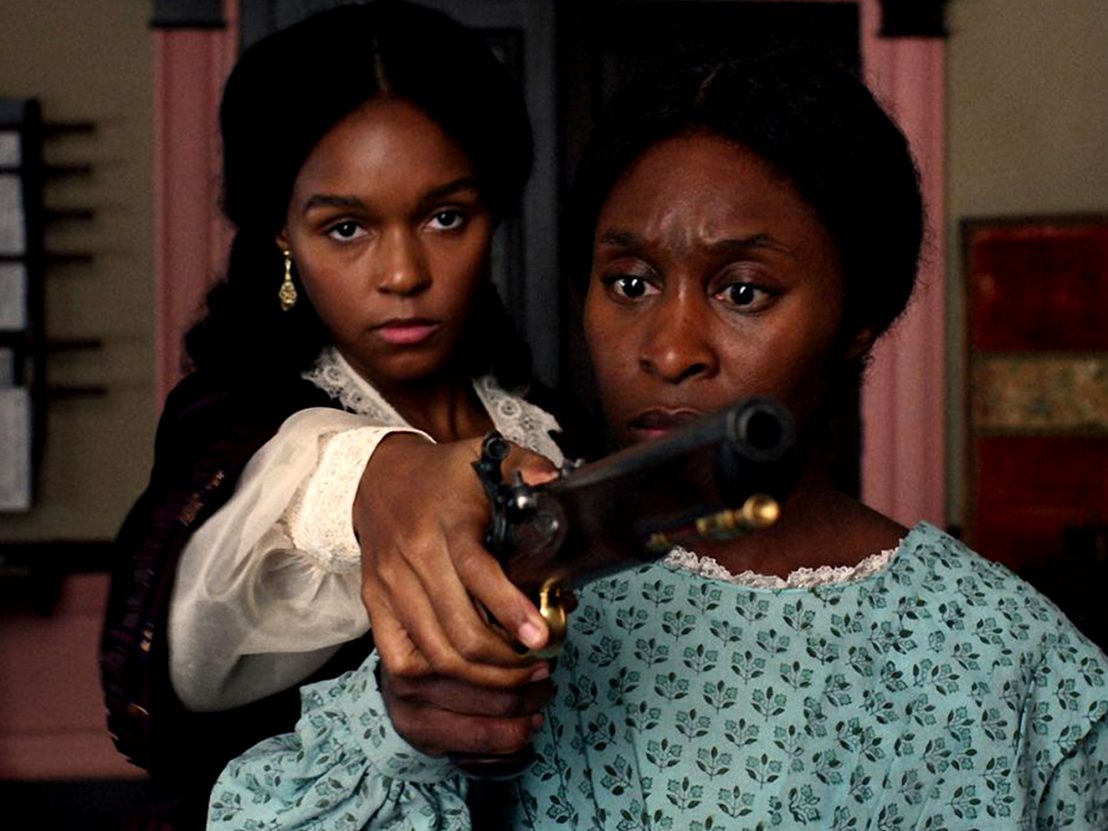

After my screening, someone shouted "be blessed all." Someone laughed and said, "you too." Even if the film leans heavily into faith-based appeal, I guess there could be worse notes to leave on in these times. Outside, a mother and her young daughter took a selfie in front of the poster--an image of Harriet, with her cocked hat and rifle--that has been buried in history books and popular imagination in favor for the older, regal Tubman in her later years. The mother and daughter smiled and walked away into our current moment. A film can't capture everything in history but when it skims a surface that wants to make you want to explore deeper, there is a value there. ***1/2

-Jeffery Berg


For further reading, I appreciated this Vanity Fair article from K. Austin Collins which has a unique perspective compared to many critical reviews I've read and why it's more mysterious, runs deep: "... there’s a tension at work in Harriet that’s missing from other, 'better' movies. Sometimes, Lemmons—who directed the wonderfully spectral Southern gothic Eve’s Bayou—hits you with a curious bit of framing or a propulsive bit of energy, visions of a world that’s as alive with danger as it is with spiritual possibility. It’s also a vaster and in many ways wilder film than it will get credit for, a movie that leans into the excitement of Tubman’s mission so energetically it almost morphs into a heist picture, dredging up odd romantic and religious energies along the way."

Wednesday, October 30, 2019

western stars


Bruce Springsteen has long been emblematic of American yearning. His new solo album, Western Stars, is a wistful, grand collection of songs. The rock edge of his previous work is more understated and spare here, giving way to a gorgeously-produced full orchestra--with remnants of homage to Glen Campbell's string-drenched Jimmy Webb-penned tunes. The gravel of Springsteen's voice adds a nice tension to the lush tracks. In the film Western Stars, directed by Springsteen and Thom Zimny, Bruce and orchestra play for a small, quiet, seated audience in his hundred-year old, worn-down barn, lit atmospherically by strewn lights.


Those expecting raucous arena rock may either be disappointed or intrigued by the deliberately-paced, string and mellow horn-laden tunes. An effective Patti Scialfa performs by his side. Her addition to "Stones" is particularly haunting and reflective and better than the track on the album release. With the exception of a rousing cover of "Rhinestone Cowboy," the film is mostly a play-by-play of the record--no Springsteen chestnut standards emerge. The staid, though vocally and instrumentally impressive, performances are interspersed with slow-mo horses over open landscapes, flitting vintage home movie Americana and some footage of a younger Bruce and Patti. The imagery is not particularly striking, but lovely and pleasing to look at; over it, Bruce ruminates in platitudes on growing old, cars, nature, relationships and the origins of his songs. Overall, Western Stars the film deepened my appreciation of the album and is a nice slice of an artist still delivering beautiful work, even if its wrapped in a sleepy shroud of stars. ***

-Jeffery Berg


Tuesday, October 29, 2019

Tuesday, October 22, 2019

ghost movies!


Meep's Retro Movie Love Podcast on Ghost Movies is now available to listen to here! It was so fun to watch and re-watch these films. I especially love listening to Meep and Ben's commentary. Ben's thoughts on The Entity are particularly well-articulated and insightful.

Audio YouTube below!