Thursday, January 27, 2022

paper mask


If I wanted to steal someone's identity and profession, a physician / surgeon would absolutely not be on my list. But in Christopher Morahan's eerily unsettling adaptation of John Collee's publishing-dubbed "medical thriller," Paper Mask, that's exactly what the main protagonist schemes his way into and signs up for. Matthew Harris (Paul McGann of 8th Dr. Who renown) plays a lowly porter in a London hospital. After witnessing a car crash outside of a pub, Harris steals the identity of the victim--Simon Hennessey (Dale Rapley)--a doctor at his hospital. The movie moves swiftly through its crackerjack plot as Harris lands a residency at a hospital in Bristol, much to the chagrin of one of its board members (a delightful Tom Wilkinson). Harris, while having a modicum understanding of medicine, teams up with nurse Christine Taylor (Amanda Donohoe), who helps him as far as she can with the occasionally stomach-churning medical mishaps that arise. A romance soon develops between Matthew and Christine, and their symbiotic vibe is both surprising and morally askew. 

In most stolen-identity thrillers, we usually luxuriate in something flashy and glamourous, not wonkish, life-or-death, stress-inducing states. So maybe that's why as an audience member, I wasn't hoping for Harris to "get away with it." Among the tradition of Highsmith-inspired cinema, while not as sensuous and sweeping as Anthony Minghella's The Talented Mr. Ripley nor as pulpy and devilishly fun as the film versions of Ira Levin's A Kiss Before Dying, Paper Mask is a chilly, straightforward yarn of human perversity. It also shows how far someone without qualifications (or with the "guise" of qualifications) can advance merely by being a sociopathic man. Additionally, the film touches upon how power structures inevitably protect the powerful. The combination of Nat Crosby's dullish-hued cinematography and McGann's plain, unembellished performance (though he goes for a bit of ham singing out The Platters' "The Great Pretender"--an obvious musical motif throughout the movie) adds to the clinical queasiness of the tale. As Harris's foe, Wilkinson injects the movie with bite. ***

-Jeffery Berg


Wednesday, January 26, 2022

under suspicion

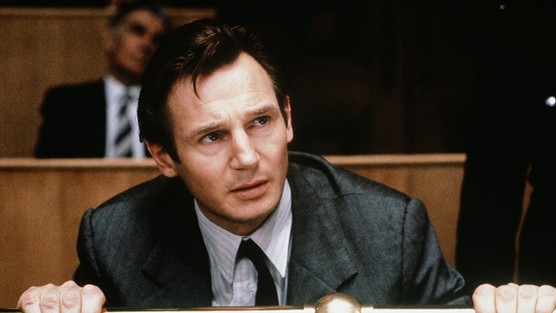
For those who enjoy Liam Neeson in hammy, melodramatic avenging mode, Simon Moore's (writer of Traffik) 1991 noir Under Suspicion, may be a let-down. It's not posh, prestigious, or tidy enough for anglophile mystery folks either. Instead, Moore's movie, mostly set in stuffy, repressed 1959 England, is sort of a dreamy, twisty erotic crime story--red-splattered and gory as the valuable paintings evoked in the film. The movie didn't make much of an impression on audiences nor critics when released, but it remains an entertaining little flick. 

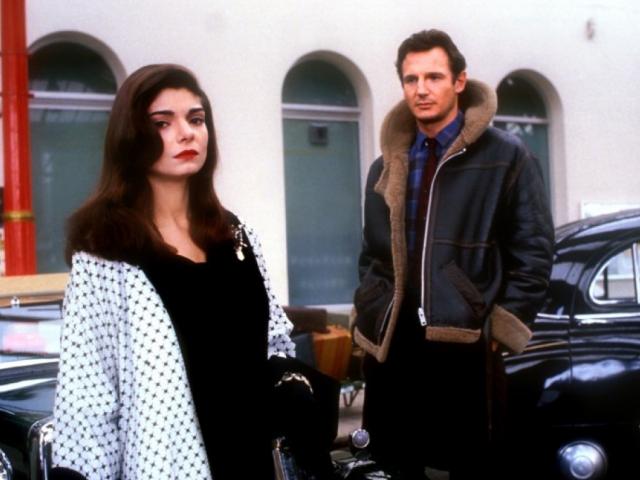
Neeson stars as Tony Aaron, a rouge photographer and private eye, who sets up shots of philandering spouses in bed with other people, sometimes even using his own wife (Maggie O'Neill). The film clearly lays out Tony's work in the main title cards: in 50s England, it was practice to have these paid set-ups of faux affairs to circumvent strict divorce laws of the time. After a tragic mishap, Aaron becomes ensnarled in the life of a wealthy woman Angeline (Laura San Giacomo) who is also a wife of a recently murdered painter. 

Under Suspicion thrives on a plot of thorny twists and its economical editing (by Tariq Anwar--who would later work on a number of prestige pictures throughout the 1990s and into the 2000s, including American Beauty, The King's Speech, and recently One Night in Miami...). One can see Anwar's gift in shaping a quick-to-the-point feature here, including an impressive, if amusingly overheated, race to the gallows sequence. Despite its trimness, Moore's movie and Vernon Layton's cinematography captures an overcast England mood and devilish intrigue. Also notable is Christopher Gunning's throbbing score. 

Neeson is particularly sexy in this role, acting with notes of bravado (and occasionally, into the overwrought). As Angeline, Giacomo is alluring and mysterious, dressed (by costumer Penny Rose) in cool, chic black hats and dresses--the kind of costumes Edith Head might have designed for Grace Kelly in a Hitchcock movie. Perhaps purposefully, Angeline feels out-of-place; Giacomo has always felt more like a contemporary performer than a period piece performer--a certain rawness that seeps through her demeanor. Nevertheless, this adds to the opaqueness of Angeline and the story's main mysteries. A sturdy supporting cast abounds including Kenneth Cranham and a transfixing Alphonsia Emmanuel. Overall, I found this lean, carnal mystery, with its nostalgic early-90s veneer, a nice diversion and a treat in an era of bloated series and films. Under Suspicion is currently available on Blu-Ray from Image Entertainment. ***

-Jeffery Berg

Monday, January 24, 2022

cha cha real smooth


Who is this early 20s Cooper Raiff Actor / Director / Writer with his sunshiny smile and zest for life, dishing up John Hughes-esque comfort food? Cha Cha Real Smooth, Raiff's follow-up to Shithouse, is energetic, amiable and moving. When a coming-of-age movie clicks, it can be a really special treasure. Strong dramedies are rare these days in a film era of more sardonic, untouchable coolness akin to Dakota Johnson, Raiff's co-star, who delivers an incredibly nuanced and emotional performance. So I was surprised how much I relished this rough-hewn flick that is as unabashedly uncool as a Bar Mitzvah dance floor. 

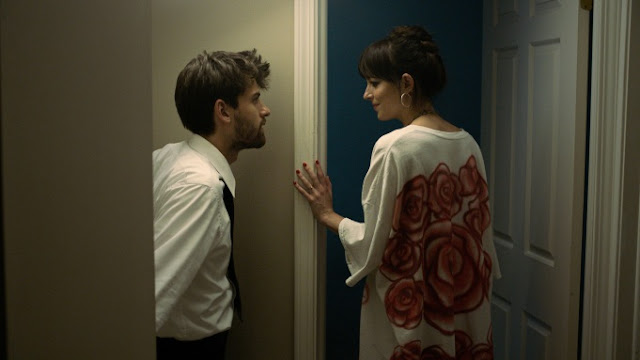
Raiff's Andrew is in the aimless post-undergraduate slump: his love interest off in Barcelona with another guy, he's working a job at an icky bright yellow hot dog place in the mall, and he lives at home with his mother (Leslie Mann, who humorously doesn't age in the story's ten year time-jump) and stepfather (Brad Garrett) and younger brother David (Evan Assante). With Andrew's knack of getting people on the dance floor at the seemingly endless cycle of Bar Mitzvahs in his community, Raiff soon becomes a hired Bar Mitzvah party-starter and also meets Domino (Johnson) and her autistic daughter Lola (an excellent Vanessa Burghardt in her film debut). Raiff quickly becomes closer to Domino and starts helping care for Lola. The plot sounds cutesy, and at times, the movie is a bit flighty and sugary, but the performances, especially from Johnson and Burghardt, neutralize the movie with a sense of mystery and emotion. When Andrew makes a statement to Domino, almost pleading and puppy dog-eyed, that he feels like she's always withholding something--it's almost akin to the mismatched styles of Raiff and Johnson themselves and makes for electric chemistry. Raiff lays it all out with fervent kineticism; Johnson is more reserved, nonchalant and enigmatic. Johnson displayed a glimpse of her magnetic qualities and range in a small but crucial role as Nina in Maggie Gyllenhaal's The Lost Daughter, so it's exciting to watch her roam freely and expressively here in a more expansive role. The movie is breezy, but doesn't feel as if it rushes through anything. At its most rom-comy substantiveness, it recalls the golden age of Cameron Crowe. Cha Cha Real Smooth is a shudderingly awkward title to type, but I was enamored with it, freeze pop color continuity problems and all. ***1/2

-Jeffery Berg

Sunday, January 23, 2022

sharp stick

Lena Dunham's Sharp Stick is essentially an L.A.-set sexual awakening story of 26-year old Sarah Jo (a fantastic Kristine Frøseth). Despite the occasional slipshod unevenness of the film--though compact in its brief running time--the excellent cast and their feeling of comradery is palpable. 

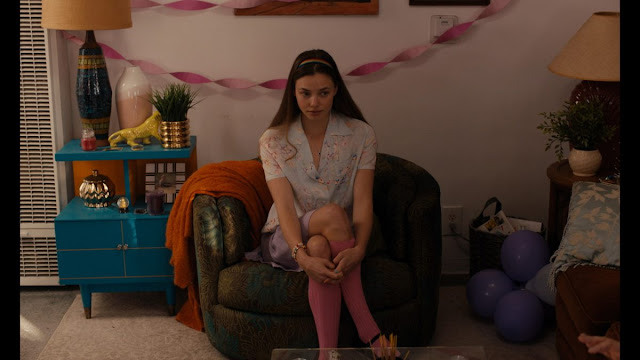
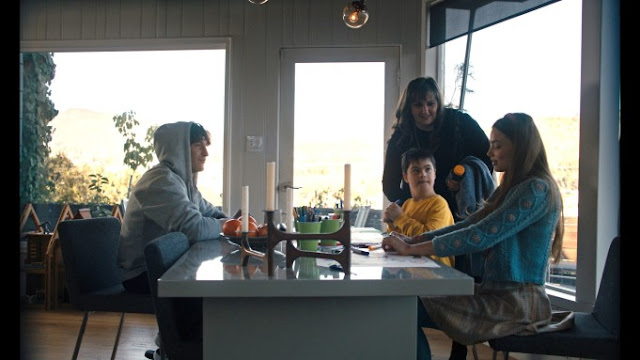
Sarah Jo is the kind of woman who is left out and ignored--her dynamic sister Treina is an influencer (a hilarious, on-point Taylour Paige). They live with their mother Marilyn (Jennifer Jason Leigh) in a drab, but sunnily-lit apartment complex that she manages. Leigh's turn as this sardonic, washed-up bohemian type who once appeared in Duran Duran videos, is heavenly, tart and a joy to watch. From the dazed, crick-in-her-shoulder dance to Khia's "My Neck, My Back" in the opening scene, to her thorny strands of adjurations for and from her two daughters, Leigh sails with the material. Also strong, surprising and fused with crackling energy is the handsome Jon Bernthal as Josh, the dad of the developmentally disabled Zach (Liam Michel Saux in a great turn) who Sarah Jo helps take care of. Josh is married to pregnant Heather (Dunham), and they live in large, sleek hillside pad. These two dwellings where Sarah Jo spends most of her time in the film, are nicely contrasted; we often see Sarah Jo awkwardly in cramped spaces--her spirit longing to roam wildfire free. In one of those cramped spaces--a laundry room--Sarah Jo seduces Josh, and the two actors run through a gamut of feelings and actions in their characters' complexities--consent, desire, nervousness; it's a wonderful scene. Eventually, Josh and Sarah Jo's relationship heats up and burns up, and Josh introduces Sarah Jo to the world of porn. 

While Sarah Jo's mother and sister express and talk about sexuality freely, they don't expect, nor treat Sarah Jo as a sexual being. In fact, Marylin doesn't even share the joints she does with Trei, telling Sarah Jo that weed will get her too much into her own mind. There are currents of ambivalence in this family: Is Marylin protecting her daughter, or further alienating, dividing her from her sister? How does Trei feel as a black woman in this white family? 

These questions linger over a seemingly breezy tale, and as with Dunham's previous work on Tiny Furniture and Girls, reveal characters in all their flawed, messy glory. Even the gregarious, bro-ish Josh isn't treated with as much villainous disdain as a lesser film would. A scene between him and Heather is fervent and well-acted, reminding one of Dunham's strong, underrated performing abilities. 

The movie moves into more farcical territory in the latter half, where Sarah Jo's obsession with a ruggedly-hot, neck-tattooed porn star Vance Leroy (Scott Speedman) and her doomed relationship with Josh, spurs the quest to sweep through an alphabetical list of sexual acts (a bit of a retread of The To Do List). This is where the picture starts to feel bumpy and less involving, despite Frøseth's zestful acting. By the end, Sarah Jo's liberation continues with both words of impassioned wisdom from Leroy himself and a promising new beau Arvin (a charming Luka Sabbat). The searing final shot, captured well by cinematographer Ashley Connor (who also shot The Miseducation of Cameron Post), is almost a complete 180 of the haunting, blistering and visceral final moment of 1977's Looking for Mr. Goodbar--one where sexual exploration is integral to a woman's demise, and one where it's integral to a woman's transcendence. ***

-Jeffery Berg


Saturday, January 22, 2022

the cathedral

Ricky D'Ambrose's elegiac The Cathedral, both a remembrance and a sort of personal filmic reckoning, is such a mesmerizing sensory experience. As we watch the years go by of an American boy's life--from the late 80s into the distressed dawn of the twenty first century--there are the constant ticking of clocks and their hushed chimes, natural light against wood floor, the gentle whir of ceiling fans, wind through trees, soft hums of traffic, the distant rumbling of a lawnmower. There's the sound of chalk against the blackboard in a school; the sound of crayon against a paper placemat; the dipping of eggs into dye. There's also the visual pops of teals and royal blues (plastic Solo cups and plates) and the earthy beige-ness (khaki pants and wood-paneling) of the eras. And moreover, there are newsworthy markers of time, on radio and television, from the World Trade Center bombing to a rousing Bill Clinton State of the Union address to Katrina. It includes items (a $39.95 road atlas; a strewn My Buddy doll; a paper cup dispenser) and commercials for items--things marketed of such value in its time (Liberty coins sold at the now defunct Montgomery Wards, Kodak Gold Film preciously sealing memories). 

The film consists of carefully composed scenes and vignettes of a family, often bickering with one another about attention and money, told through the images and also the voiceover of a distant-feeling--almost Barry Lyndon-style-- narrator. The Cathedral skims through young Jesse's life, sometimes hovering over the mundane: a sleepy afternoon of daytime naps and Crayola magic marker coloring to larger family gatherings of events pivotal in his life--his third birthday, his confirmation, high school graduation, and funerals. Jesse is extremely quiet and reserved throughout, described often as a "sweet boy." In the meantime, he shows a budding interest in visual arts--going through pages of a book, whether it be images of grand architecture of a cathedral or movie scenes and stars; taking his camcorder to record little details within his occasionally volatile father Richard's (played with great grace and panache by Brian d'Arcy James). There's such a--I sense intentional--flatness to Jesse (where are his friends? where are his adolescent outbursts?) and in the acting of the young actors that portray him (Robert Levey II and William Bednar-Carter), that he almost becomes character as camera. In what feels like close, autobiographical material of D'Ambrose, D'Ambrose's camera (shot on digital by cinematographer Bart Cortright with a late-1980s lens) in turn, is another layer of meta. The familial dramas were less interesting to me than the construction of the movie--and perhaps that's also intentionally so. In one striking moment, Jesse describes a prosaic-looking 1989 snapshot of two family members by answering a litany of school assignment questions. These questions are also pertinent to The Cathedral itself--a spare, but extraordinarily intriguing achievement. ***


-Jeffery Berg


fresh

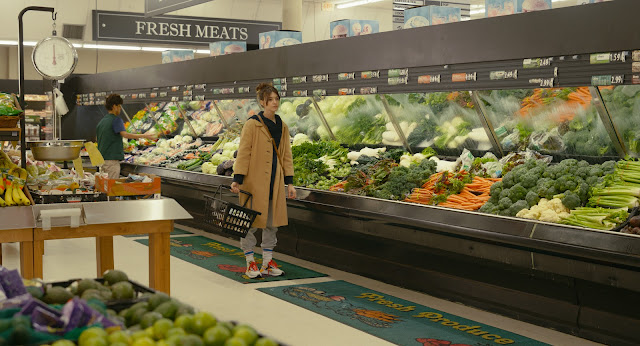
Who exactly is Steve--the "mist-ery" man (Sebastian Stan) drumming up a meet-cute in the produce aisle? Director Mimi Cave and Writer Lauryn Kahn's horror trip Fresh takes on the perils of online dating, from awkward minor awfulness (especially the behavior of men) to an ultimate plunge into the very worst and unimaginable. From the jump, there is a foreboding concentration on food and flavors--among them, cherries, cotton candy grapes, nectarine, and short ribs. Also, through the uneasy camerawork (by Pawel Pogorzelski of Hereditary, Midsommar), we know something isn't quite right about Steve and Noa's (Daisy Edgar-Jones) sloshy date night, despite their cutesy banter. Soon we are taken to a cavernous home with no cell service and suddenly, another half of the movie snaps in place. 

Cave's film harnesses the sleazy 70s drive-in movie vibe and the winking social commentary of early twenty first century horror. Pogorzelski's photography is faded and dark, not too slick, despite its gleaming pops of cell phones (well-used here in moments of humor and suspense, as sometimes they are just gratuitous in other movies). The film is full of comic flourishes too. A rampant use of trippy pop and soul music cues: take a piece of me, a lyric flares while Noa's likable best friend Mollie (a fun Jojo T. Gibbs) searches images of plastic surgeons. Sometimes it goes a little too far into the corny territory: like a cheeky dance sequence set to Animotion's "Obsession" or a sunlit run to Lou Reed's "Perfect Day"--a little too pat and a little too faux Patrick Bateman. Nevertheless, despite a few flaws and a baggy runtime for the material at hand, Kahn's twisty narrative, fine performances and smart references make for a good, stomach-churning, crowd-pleasing romp. ***

-Jeffery Berg