Showing posts with label kristen dunst. Show all posts
Thursday, September 28, 2017
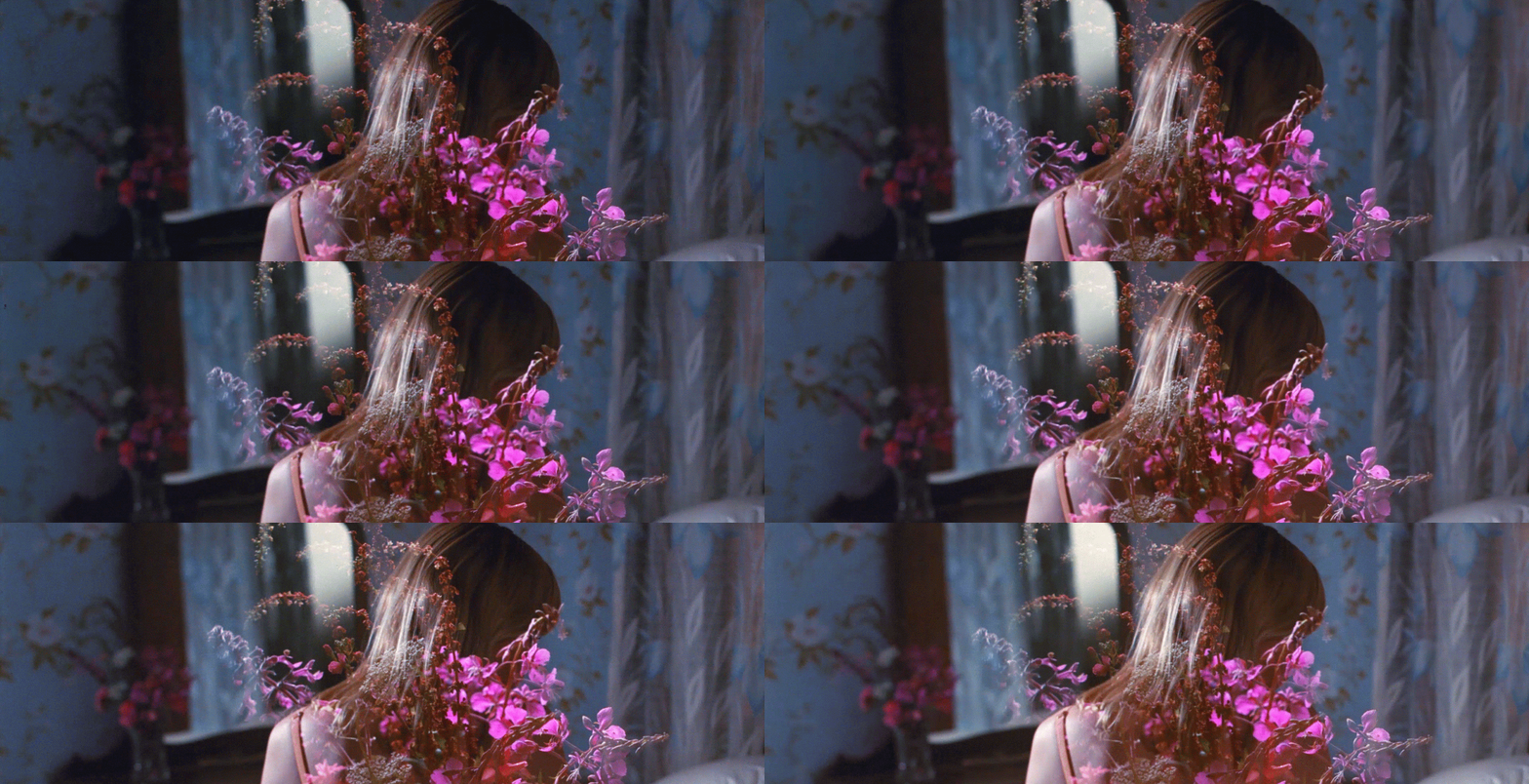
woodshock
Soundscape like amplified tones of a finger on the rim of a wineglass.
Nature as a possessor: Kristen Dunst smokes up and sleepwalks through the dreamy ins and outs of her existence in the wake of her mother's death.
Somewhere in the redwoods--trunks like the feet of dinosaurs
Trees as living bodies. Hands caressing bark. Hands caressing wood paneled walls.
Tightly tying a ribbon on a nightie.
Blond-lit photography. Elements of trees: wooden dresser, papers to flame, leaf-adorned curtains.
K.K. Barrett did the tactile art direction. The artist behind the visionary sets of Her.
Whenever men appear, the dream world is broken with less interesting imagery and sonic volume--usually fuzzed-out indie rock strumming around them, their hair and beards the color of wood.
Songs like "Dream Baby Dream" by Suicide.
There's the dissonance of synthetics versus natural--plastic baggies--a plant shaped neon light, the automatic brushes in a car wash.
A sleek and stark dispensary in what used to be a flower shop.
Earth drugs as a possessor.
Campfire-lit house party. Tapping at goldfish in an aquarium. Lit match blowout.
Misty, rain-glazed car windows.
The film is directed by Kate and Laura Mulleavy, the sisters who founded Rodarte. Their filmmaking is visually appealing. The film throbs.
Their sartorial choices for Dunst: soft, muted, white mohair (?) sweater, waffle thermal shirt. Black bra and jeans.
A house mostly cut off from the accouterments of popular culture.
A mustard princess phone. Eggs gone bad in the fridge. Cake adorned with flitting moths.
Prisms through trees. Prisms through a crystal vase.
Some of the dispensary customers begin to die.
Dunst is like a bird in a cage that perches itself at the end of a toothbrush. Like the goldfish behind the aquarium glass she taps upon.
Sudden curdling of strings during levitation.
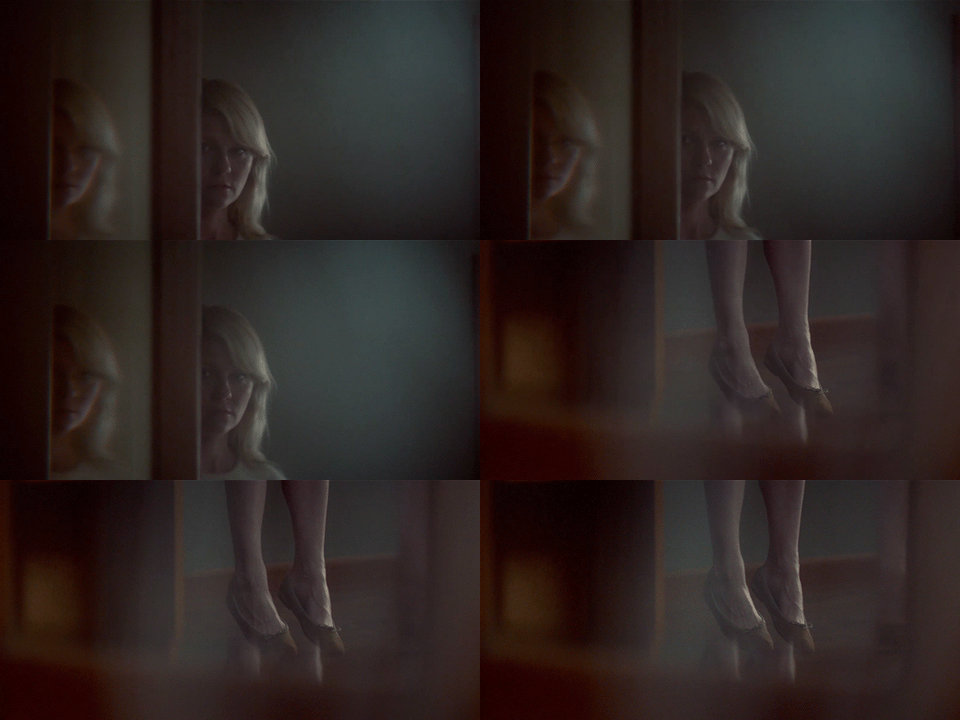
Faces and bodies cut in mirrors like a forest of trees.
Dried flower overlays.
Berry-stained lips.
Blood splattery mist of wood shavings flying at the chainsaw's cut.
The final dress is a wisp of a silvered sheath.
The film is for ones who like to be left under a spell. ***
-Jeffery Berg
Friday, June 23, 2017
the beguiled
Nicole Kidman plays the headmistress running the mansion, who lost her husband to war. Kristen Dunst is the main teacher, attracted to the Corporal and also to his idea of running away with him out West. We sense the loneliness from both the aesthetics (pent-up emotions in stitching and the tied knots of ribbons) and the actors themselves--Dunst in particular feels the most immediate. Kidman still delivers the best ice-glares of any living film actress but also discovers an acute physicality in elegant and symbolic poses--a brave protector of sorts of her girls. And Farrell always has a knack of absorbing his characters believably and without hesitancy. Elle Fanning as the loopy, more brazen student, is, perhaps purposefully, affected with more contemporary acting choices and colloquial language.
The film is based upon a novel by Thomas P. Cullinan which was adapted in 1971 by Don Siegel for a movie starring Clint Eastwood. Supposedly that venture is much pulpier. Sticking to her trademark style, Coppola's fever dream is visually pitched in muted creams and pinks, with dark backgrounds. There's even the frilly pink lettering of the main title card (similar to the girls' cursive lessons). The cinematography by Philippe Le Sourd is fuzzy like strained eyesight and mis-remembered memories. We watch candle lights flicker, the pale faces of the women and young girls lurk in and out--their dresses glowing faintly in soft-colored cotton and satin. It's beautifully orchestrated, as Coppola's films usually are, with a sharp exquisiteness and a hushed somberness. Like the pet turtle in the movie, slowly moving about, nestled in its shell, there's a sense of isolation and of being cut off from traumas just outside of the setting's perimeter (as in Marie Antoinette): off in the near-distance are passerby soldiers on horseback in the mist, the muffled booms of cannons--smoke rising from trees--a quiet rattling of their coziness and structured daily lives. There isn't much of a soundtrack though this time. Instead Coppola selectively employs brackish, dirgey electronic long notes from Phoenix and the schoolgirls' hummings and out-of-key vocal, piano, and sawing violin renditions of rounds and Stephen Foster tunes. There's also the sound of war muted by distance overpowered by the locusts and the birds (are they larks or just robins?). However the aesthetics are sometimes somewhat out-of-sync with the source material. Even though the more sensationalist, plottish moments (unfortunately predictable thanks to heavy-handed symbols and the movie's thriller trailer) fizzle, perhaps the polarization of these times in America adds to a simmering intensity to the picture right now that the film itself may lack. ***
-Jeffery Berg
Friday, February 10, 2017
the beguiled
Sofia Coppola (who always delivers a visually stunning treat) remake of The Beguiled looks interesting.
Tuesday, October 18, 2011
"it tastes like ashes."
Lars Von Trier films often thwart and redefine aspects of aesthetic beauty. The blue planet romantically called 'Melancholia' in his latest picture is both a sensuous vision and an apocalyptic terror. His twinned story follows Kristen Dunst as glum newlywed Justine and her sister Claire (Charlotte Gainsbourg). Set in a rambling, remote castle of Claire and her husband John (Kiefer Sutherland), Justine awkwardly flits in and out of her reception in a stuffy white wedding gown and in a slew of events, loses both her job as an art director and her simplistic new husband (Alexander Skarsgård). The second act focuses upon an unnerved Claire trying to take care of her depressed sister. As Melancholia approaches Earth (evocatively photographed in the film's sans dialogue opening sequence), Claire becomes more and more rattled by the prospect of the extinction of life while Justine calmly waits it out.
At times creaky, Von Trier frustratingly purges many of his exposition's interesting plot lines and characters (including Charlotte Rampling as Justine and Claire's mother who rants against marriage) and centers upon the psychological fears of earthy Claire and the nihilistic Justine (similar, it seems, to the collision of the two planets). Gainsbourg is the dramatic anchor the film needs. While no one comforts her, including her cold husband, she sympathetically tries to ease her sister. Horseback rides in the fog, a favorite dish of meatloaf ("it tastes like ashes") don't please Justine for very long. In a complicated performance, Dunst oscillates between downbeat grief and a sort of determined and confident anger ("The earth is evil. We don't need to grieve for it," she bluntly intones to her sister). Von Trier has said of her character: “She is longing for something of true value. And true values entail suffering. That’s the way we think. All in all, we tend to view melancholia as more true. We prefer music and art to contain a touch of melancholia. So melancholia in itself is a value. Unhappy and unrequited love is more romantic than happy love. For we don’t think that’s completely real, do we?” Von Trier's handheld cam doesn't linger too much on the beauty of his actors or the picaresque setting (something out of a Vogue shoot; the golden-hued bridal bash appropriate for Vanity Fair) or the castle's crown molding. The proceedings are even backed by Wagner's grand Tristan and Isolde overture. But Von Trier isn't one for lush comfort, in effect, he annihilates it. ***
-Jeffery Berg
Subscribe to:
Posts (Atom)


