Showing posts with label spencer. Show all posts

Friday, January 28, 2022

jeffery berg's top 10 films of 2021


Putting 2021 behind me now... Here goes my top 10 films of the year. 


10. 

WEST SIDE STORY


Steven Spielberg's bold and entertaining take on this enduring musical isn't perfect, particularly in its deviation from Jerome Robbins' classic, subversive ballet-choreography to something more primal and physical, but it remains an exciting statement, and the sparky ensemble cast, specifically Mike Faist, Ariana DeBose and sweet-voiced Rachel Zegler, infuse these characters with new life on the silver screen. Per usual with Spielberg, the crafts are dizzyingly top-notch, but Leonard Bernstein's absolutely gorgeous score and the late Stephen Sondheim's book, are powerfully evoked and orchestrated in this new version. In a different time, it may have been the big event movie of the winter, but with fears of a new, rampant COVID variant and the lopsided excitement for the next Spider Man installment, the movie didn't perform to its expectations. Still, was a simultaneously rousing and tragic watch that I can't wait to see again.


9.

LICORICE PIZZA


I took a solo trip on Thanksgiving evening to catch this on 70 mm in the East Village (my old stomping grounds). It's also here I first saw The Master, now ten (!) years old. Licorice Pizza was an enveloping experience. Paul Thomas Anderson's film is a successful visual and tactile journey back to the early 1970s, but it also rides primarily on the absolutely phenomenal performance by newcomer Alana Haim, who does everything here so naturally and with panache. There are also funny and biting bits by familiar faces, particularly Bradley Cooper and Harriet Sansom Harris. These supporting players' characters tend to be so unabashedly awful and so of their time; meanwhile, Haim and Cooper Hoffman's duo navigates their swirling, confusing affection for one another.


8.

SPENCER


I've been kind of bummed to see the divisiveness that this film has conjured, but I really should not be surprised. It's a bleak outlook on Princess Diana's place within the royal family (and in our memories), and her dream-like, fantastical attempts to re-invoke her name and her past. It's also claustrophobic and repetitive in its chilliness (and very literal with everything), even though its all juxtaposed by sumptuous sets (still can't forget that teal-tiled bathroom!) and costumes. I also responded to the conflicts the film was having with itself: its seeming disgust with itself was fascinating to me. I was here too for Jonny Greenwood's vaulted, melodramatic score in all its variations. 


7.

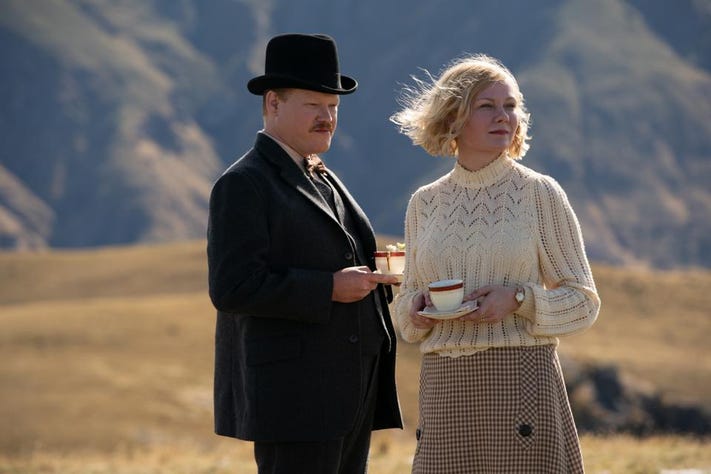
THE POWER OF THE DOG


While this film didn't hit with the emotional sweep it seems designed to, it's still a devilish, thorny yarn, brought to life by Jane Campion's beautiful direction. It doesn't really need to be said, but Campion is just a such great director--and here, her actors all shine (even Jesse Plemons in the quietest role) and the visuals are stunning.


6.


WHEEL OF FORTUNE AND FANTASY


Ryûsuke Hamaguchi has been beyond praised by critics for this year's rambling, wistful Drive My Car, but this film spoke to me much more deeply and viscerally. I found its tryptic of stories incredibly well-written both in dialogue and structure. The performances, too, by the enigmatic ensemble were a highlight. The third story in particular has an airy note of the absurd and the melancholy. A really fantastic film.


5.

THIS IS NOT A BURIAL, IT'S A RESURRECTION


A truly unforgettable and disturbing film of people being moved to the margins until they cannot possibly exist any more. As many films in recent years, like the haunting Aquarius, the conflict of the promise of "progress" versus the soul is analyzed in a bracing way. Mary Twala, who passed away in 2020, is piercing, with a face that invokes so many stories.


4.

PASSING


I have long been a fan of Nella Larsen's work, so it was exciting to see an artist as thoughtful and rigorously intelligent as Rebecca Hall adapting this for the screen. Between Tessa Thompson and a breathtakingly good Ruth Negga, this tale of two women in 1920s Harlem is a glorious achievement. And the film is shot exquisitely and symbolically, but not in a distractingly overstated way, in black & white by Eduard Grau.


3. 

THE FATHER


This is considered more of a 2020 film, but because of the pandemic, it really didn't reach a screen for me until the early months of 2021. I somehow thought it was going to be a pearly, sentimental tale of a daughter taking care of her father struggling with dementia, but it was anything but. It's almost like a gothic Polanski horror picture as it delves into the state of dementia first hand, our sense of place and time constantly subverted and twisted. A confident and stunning directorial debut from Florian Zeller, based upon his play. The Anthony Hopkins performance and moving finale is one for the ages.


2. 


QUO VADIS, AIDA?


I'm realizing now that most of my list are pretty upsetting movies, or movies that deal with traumatic histories. But alas, we live in pretty traumatic times. Many of the greatest films of the year seemed to be able to capture the sensibility of now while also harnessing tragedies of the past. Tight and tense, Jasmila Zbanic's film plumbs the depths of the Srebrenica massacre through the lens of a translator.


1.

THE WORST PERSON IN THE WORLD


Sometimes one can't logically explain how a movie is great because it just slams you in such an emotional way. I was humming along nicely with Joachim Trier's film and all its perfect performances, bittersweetness and idiosyncrasies, and then by the end, I was sucker-punched--alive, buzzing, wired, and terribly sad all at the same time. Rarely does this happen, and I'm so excited it did.


Other notable / favorite films of the year (in the sort-of order of preference at the moment):

The Green Knight, Summer of Soul (…or, When the Revolution Could Not Be Televised), Mass, CODA, Rocks, Zola, The Tragedy of Macbeth, Two Gods, The Last Duel, Bad Luck Banging or Loony Porn, Flee, Bergman Island, Judas and the Black Messiah, Preparations to Be Together for an Unknown Period of Time, The Killing of Two Lovers, Azor, Procession, The Humans, Test Pattern, Tick, Tick… Boom!, Ascension, 7 Prisoners, A Hero, The Velvet Underground, Candyman, Prayers for the Stolen, The World to Come, Shiva Baby, There is No Evil, Wrath of Man, Two of Us, Pig, The Fever, The French Dispatch, Luzzu, The Hand of God,  The Lost Daughter, The Alpinist, Attica, Drive My Car, C’mon C’mon, Memoria, House of Gucci, The Salt of Tears, Who You Think I Am, Val, The United States vs. Billie Holiday, Copshop, Last Night in Soho, The Many Saints of Newark, Red Rocket, Nightmare Alley, The Night House

A look back at my Top 10 films of 2020.

Friday, November 5, 2021

spencer

Pablo Larraín's Spencer follows Princess Diana (Kristen Stewart, in a showy but affecting turn) within a few days of the Christmas holiday at a remote manor, near where Diana herself grew up as a child. Part of the mystique of the royal family--recently, there have been a slew of notable portrayals of them--is that we can truly never know everything about them. They stand somewhat removed from us, even though they are integral to shared world events, with chilly glamour. What makes Larraín's film, written by Steven Knight, so bold, is that goes inward, with tenuous grips on the factual. It's a swirly psychological portrait rather than a rigid biopic or even a rigid sketch. What may be most accurate, is Jacqueline Durran's attention to Diana's dazzling costumes: chic ensembles of the early 90s, especially designed for Diana, for each event of the day (church, dinner... and longingly, for Diana, as her finger runs over the tag--the day of departure). 

Many of described the opening of the film (noted as a "fable within a tragedy") with Diana, late to the gathering at the house, driving her convertible to a roadside eat-in, symbolically saying not knowing where in the world she is. But actually, the film begins with a extremely militaristic and dour set-up within the hollows of a spacious kitchen with the righting of the staff (this is such a deep contrast to the puff-pastry, lightly comic upstairs / downstairs shenanigans readying for a Royal visit in Downton Abbey, a pre-COVID picture release, and just a year after Prince Harry and Meghan Markle's indelible wedding ceremony; Spencer happens to land in the year of Harry and Meghan's termination of being senior royals and their stepping back of being representatives of the Queen). Already, we can feel the stuffy, airless quality of the house and its guests and staff (including large-eyed Timothy Spall as a very-watching watchman). Spall's effective turn manages to be both imposing (especially when he creeps upon Diana in what could be embarrassing moments) and pathetic (when considered how he merely is a small cog in the machine of the royal's loyal workforce). The roaming house is constantly referred to, especially by Diana's young children, as cold. Knight's on-the-nose symbolism may be too much to bear for some [doomed pheasants, stitched-closed curtains, the Queen (Stella Gonet, her haunting countenance) in one of her only verbal communications in the film, basically pinning Diana as "currency"), but I found its metaphors enjoyable, like those laden within a musty, old-fashioned read, and distancing from a potentially emotionally-wrecking movie; the script's parable qualities almost akin to sweeping journalistic generalizations of the royals, and of Diana herself. 

We see Diana, adoring her children and her children adoring her as well; we also see the close friendship of her and her dresser Maggie (Sally Hawkins, another strong supporting actor in a small role, infusing it with complexity). Otherwise, this is a universal absence of human warmth. Her husband Charles (Jack Farthing) is portrayed in brown-beige gloom as a grotesque shell. 

Naggingly, off in the fog-drenched near-distance, is Diana's childhood home, the estate of her titular maiden name, a lost touchstone of dirt-on-the-knees happiness and the what-could-have-been, now abandoned, with crumbling stairs. Some of have said this isn't factual, which of course, isn't the point of this film; this nightmarish fairytale strives to create an overriding feeling of longing. Even knowing that Diana died too young, a mere few years after this film seemingly takes place, is enough to cement this as tragic. As we run through a montage of her in various dispositions in iconic outfits, the outfits are truly cinematic; they are equally important (that ruffly, white wedding dress of optimism, Stewart beaming in it) as they are meaningless. We've seen many movies of violence against others, to the point where we may be numbed by it, but the violence against oneself, is still tough and triggering for many--is it because humans, fundamentally, are wired to survive? Spencer shows Diana's bulimia in many demanding ways. While watching Diana cower over the toilet in a white gown speckled with gold, I couldn't help but be entranced by the surroundings: the gorgeous teal tiles and brass fixtures of the breathtaking bathroom. Is this sharp dissonance between aesthetic and bodily trauma part of Spencer itself in presentation and of its subject? I am reminded too of Larraín's treatment of the blood-stained pink Chanel suit of Jackie. This can be off-putting to some, but I found Spencer completely entrancing for its layers, its push and pull of disgust seemingly with itself and its subject's push and pull disgust with herself, and the film's charred melancholy. 

The fuzzy, peachy-maroon cinematography by Claire Mathon imbues the picture with the irretrievable. Jonny Greenwood is back with another jolting score that adds to the ostentatious and untethered feel; one of the main themes is an exquisite piano melody that scales up and down and around, including over the title card and a Kubrick-esque high shot of Diana in her convertible (admittedly, it was then I knew that this movie was hitting me). The melody returns on pipe organ as a funereal dirge as the royals depart the Christmas church service. As with many moments of the movie, including the ghost of Anne Boleyn (reminiscent somewhat of Hitchcock's lingering ghost in Rebecca), there's almost a darkly wry humor to the music's use there. As with the burning of Rebecca's Manderley, Diana and Larraín will burn everything down with Mike + The Mechanics and KFC.

Kristen Stewart is an actress I find very watchable, but not always convincing; in Spencer, while occasionally losing myself in it, I find I am watching Stewart busily play Diana--wiry nerves, clipped British accent and all. Yet, that idea of performance, the casting of a renowned celebrity actress playing a renowned celebrity, is part of this movie's charm, charge, and sadness. Ultimately, Stewart's portrayal of this harrowing inner turmoil is compelling. ***1/2  

-Jeffery Berg