Showing posts with label scarlett johansson. Show all posts

Thursday, June 15, 2023

asteroid city


My review of Wes Anderson's Asteroid City here on Film-Forward.

I wasn't as over the moon (so to speak) as some. But there definitely elements of it that were quite strong.


Tuesday, November 12, 2019

marriage story


Situated near Trump Tower and the Plaza Hotel, the no-frills, yet inherently classy Paris Theater in New York City has a history of single-screen showings of films that appeal to the upper-class and intellectuals. After its recent closure, streaming giant Netflix swept in and re-opened it. It feels like a splashy and perceptive PR move: usher in screenings of their slate of films like Noah Baumbach's Marriage Story that were refused showings in chain cinemas for awards season consideration, while also rescuing an institution of cinema-going. Marriage Story in particular speaks to the sort of audience who would go to the Paris Theater--a classy set, craving complicated, grown-up entertainment which has become more scarce yearly in movies. I came to the Paris on a mild Fall morning on the eve of Veteran's Day--barricades and security around Trump Tower, more stacked than usual, before his impending arrival for the day's ceremonies. The theater was half-full, an older crowd mainly clad in black coats. In the cold-ish dark, it felt like the set-up for a stuffy experience. Ultimately, however, Marriage Story emerges, like its influential predecessor, Robert Benton's Kramer vs. Kramer, as something much more warm, earthy and broad-appealing than what a typical upper-crust character study may imply.


Baumbach's films, in dramatic and witty ways, look at characters in crisis. They are mapped out with alluring, but seemingly no-nonsense theatrical flair. They feel studied, beautifully executed and organic at the same time--a miraculous combination that has made Baumbach a fixture but also underrated as an auteur. Young couple Charlie (Adam Driver) and Nicole (Scarlett Johansson) are going through a bi-coastal divorce, while raising their young son Henry (a nod to Justin Henry?), played by Azhy Robertson. As their relationship is fraught romantically, they are also coming apart in their livelihoods. Charlie wants to maintain his creative life in Park Slope as a talented New York theater director. Nicole wants to establish herself outside the confines of performing in Charlie's work, by shooting a pilot in Los Angeles, while also yearning to become a director herself. Like the couple in Kramer vs. Kramer, Charlie and Nicole have a somewhat enviable status (Charlie nabs a MacArthur Genius Grant), but with the aid of the gifted players portraying them, the characters emerge as sympathetic and whole in their personal tumult, especially as they battle their lives through the harsh (and harshly-lit) courts; Laura Dern, Alan Alda, and Ray Liotta play lawyers with their own specific personalities, battles and at times, morally suspect agendas--some more blatant than others.


All of the dramas and poignant comic moments are drawn exquisitely by Baumbach and his talented crew. I've always been a fan of the editor Jennifer Lame, who did such lovely work on Baumbach's Frances Ha. It's the kind of non-flashy editing that often doesn't get recognized. There is one symbolic scene in Marriage Story, involving the closing of a gate, that's one of the best edited sequences I've seen this year. Throughout, as we see the couple and lawyers spar, the awkwardness of family life, the rhythms of the film are achingly apt. Shot by Robbie Ryan (The Favourite), the movie captures both the New York setting and L.A. settings well, especially interiors. 


I was entranced by Randy Newman's score. It's a risky one for these times: tuneful, romantic; sprightly strings, horns, and reeds.  Definitely a score of late bygone sensibilities (almost like silent film ragtime-esque score re-writes) that's been out-of-style for decades. Immediately, it establishes the singular atmosphere of the picture. The movie opens with a whimsical portrait of what both characters "love" about one another--through a scattershot of imagery. It's completely charming and ends up culminating in a devastating way. Overall, music in the film is elegant and spry, but also fragile, and compliments emotionally raw moments of the story effectively. A particular Broadway musical chestnut becomes a naked expression of Charlie's bewilderment at his situation.


Outside of its technical merits, Marriage Story boasts a terrific ensemble. Johansson hasn't been given a role as strong in quite some time--and she kills. Often with tear-rimmed eyes, and an expression of emotional exhaustion, she gives a layered turn. A monologue in her lawyer's office is an impressive moment: it's an actor's showcase, but you also feel her character deeply through her delivery and specificity of action. Driver has always been a fun actor to watch. Here, he's in one of his deepest, most vulnerable roles. I couldn't help but tear up at his gangly "Invisible Man"--earnestly and desperately trying to create a fun Halloween for his son in sprawling, late night L.A. There's plenty of moments like these of quiet tenderness and bittersweet, physical comedy that's just as wrenching as a painful, drab-apartment-set shouting match. In supporting parts, Laura Dern is electric as high-powered attorney Nora. Had she not already been so wicked in her Big Little Lies turn, the performance would be even more startling. On a surface level, she emerges as a sort of villain in Marriage Story, but in hindsight, she's something more complex, especially after a biting, delicious monologue towards the end of the picture--you can see she's surviving (and thriving) in an extremely flawed system. In contrast, Alda is appealing as a fuddy-duddy lawyer in his cluttered office, seemingly beleaguered by the system and amusingly weary from his own rocky past relationships. It's great to see Airplane!'s Julie Hagerty so pitch-perfect, funny and believable as Nicole's mother. And Merritt Wever, who was so utterly fantastic in this year's Unbelievable series, is great in one of the movie's funniest screwball scenes. Even actors in bit parts, like Martha Kelly as "The Evaluator," are outstanding. I felt most distant from Henry's character, perhaps because the movie is mostly entrenched in the perspective of adults. Azhy Robertson does good work with a tricky role that could easily be too precious or irritating.


Released at the end of its decade, Kramer vs. Kramer was the top-grossing film of 1979. Mainstream audiences flocked to see it in the theater! It was a cultural phenomenon. It had a Vivaldi soundtrack and was a zeitgeist picture of its time! I doubt at the end of this decade, Marriage Story will make the same impact. As Netflix holds its grip on striving to both capitalize on auteurs making great movies and also drive pronounced competition against traditional movie-going, we, as American viewers, are left at the end of the 2010s on wobbly territory (like the uncertain leasing of a single-screen theater) for the future of the movies and its experience. We get more bang for our buck for spectacle on widescreen, but as I got up and left the picture, passing a woman sobbing alone in her seat as the end credits neared their conclusion, the lights coming up a little bit in the Paris, I felt immensely touched and satisfied. With Marriage Story, Baumbach affirms the power of the art-form through the compact, fleeting time frame, script, visuals, references, and rich performances. It couldn't be anything else but a movie. ****


-Jeffery Berg

Thursday, May 8, 2014

spring movies


Jonathan Glazer's Under the Skin is like a wet nightmare. Set in drizzly, perpetually overcast Glasgow, mysterious Scarlett Johansson acts as our tour guide, driving and meandering about countryside, castles, deep woods and also clusters of modern malls, bland housing complexes and pulsating discotheques.  It's a bit unclear what exactly Johansson's character is--perhaps an alien lifeform.  We watch her allure men to a dreamy, watery other-world within a rustic flat. Supposedly Glazer secretly filmed the film's extras, which explains how authentic and interesting they are--a sea of unique faces and an array of body types unusual to see depicted in movies these days.  The scientific observational but also humanistic feel of these sequences brought me closer to the main character's odd dance between mechanic and sympathetic. While the imagery of Johansson is quite captivating--her black bob, put-upon accent, and full red lips--she also composes an unsual being that feels immediate. The film is mostly an atmospheric and hypnotic chiller, like Glazer's last picture Birth, with a terrific brittle string score by Mica Levi (his first!). I appreciated the ambivalence of the film and can understand the meaning in its repetitiveness but I do think it could have been trimmed slightly as it gets a bit wearying towards the finale.  Like the city itself, Under the Skin feels like an old, ancient horror story with newer stylistic choices encroaching upon it. ***


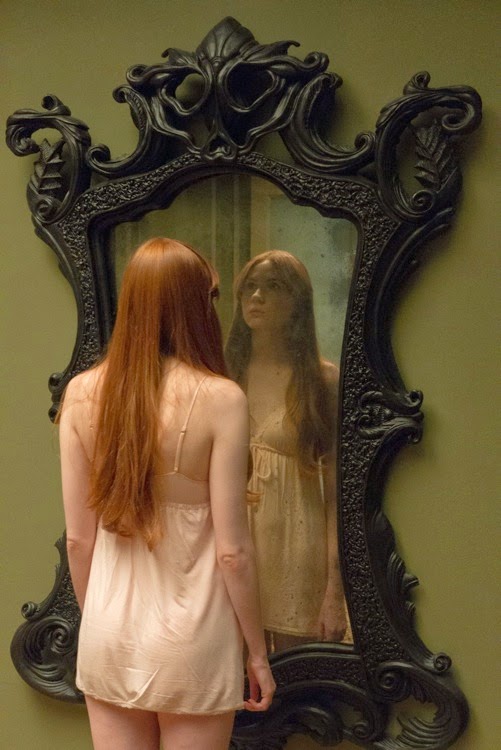
Oculus (not to be confused with the virtual reality machine) is an original, surprisingly solid horror flick. Mirrors have long been a source of creepy thematic imagery--I'm thinking especially in 1945's Dead of Night.  The curled-edged antique monstrosity with a long, menacing history in Oculus hangs on the wall of an office in a suburban home in the early 2000s. The film follows the home's children, ambitiously cutting between present day and a traumatic past. I can't commend the movie's awkward, uneven acting, but kudos to the trickery and dark-natured humor (it quietly lampoons suburbia and soon-to-be-obsolete high-tech gadgetry) Mike Flanagan (he directed, co-wrote, and also keenly edited) often pulls off. ***


The Polish movie Ida by Pawel Pawlikowski is a quietly powerful piece, gorgeously evoked in the clear-eyed and expressionistic tradition of Dreyer, that hits hard in its concise 80 minutes (I wish more of the overly shaggy movies these days would take this cue).  Set in the earlyish 1960s, a young nun (Agata Trzebuchowska) visits her Aunt Wanda, a judge (Agata Kulesza) and learns that she was born Jewish and her family was murdered during the war.  The film feels slender, like a novella, but not slight and it is beautifully shot (the evocative black and white cinematography is by Lukasz Zal and Ryszard Lenczewski) with unexpected, meticulous cuts (the editing is by Jaroslaw Kaminski).  The soundtrack is an unusual mix of genres and is well-chosen, especially the haunting John Coltrane tune "Naima." With her hardened countenance, dark eyes, and dry humor, Kulesza is fantastic as the guilt-ridden, fiercely intelligent, hard-drinking Wanda whose guilt and despair puts her in between two paths on how to move forward with her life. The movie is a potent study in circumstance and what we cannot change. ****


-Jeffery Berg

Thursday, January 2, 2014

some december movies


American Hustle

I've long been fascinated with America in the 1970s, so I found the exaggerated 70s Long Island con artist world of American Hustle particularly gleeful to watch but I can definitely sympathize with the detractors of David O. Russell's indulgent, needlessly complicated style.  What a better lead to have to guide you through an indulgent, needlessly complicated movie than the indulgent, needlessly complicated actor Christian Bale? I loved him in this and the warmth and campiness (that bedraggled toupee that opens the movie... a pretty obvious set-up for a story of falseness and disguise) he brought as the spearhead of Abscam. This is flashy stuff: the camera's always moving, people are always conniving and arguing, and music is always playing (Could there have been a more unique, better array of 70s music though? But Duke Ellington's seductive and brassy "Jeep's Blues" figures nicely).  Like its characters, the movie is gussied up--all sound and fury with a pretty hollow center.  However, I still found myself reveling in O. Russell's boozy showboating and the sparks of the ensemble (Amy Adams and woozy, unhinged Jennifer Lawrence have some terrific moments as does Jeremy Renner and manic and permed Bradley Cooper; and also welcome are Robert DeNiro and Colleen Camp in small bits). ***1/2


Her

As Joaquin Phoenix's heartbroken Theodore falls in love with his operating system (the disembodied voice of Scarlett Johansson), writer / director Spike Jonze does some amazing world-building in his near-future L.A.-set Her. There's a lot of blazing orange, clean surfaces, high-waist pants, collarless shirts, buttoned-top buttons, and sardonic video games. I kept wondering what was going on outside of this relatively plush-looking, stream-lined yet slyly garish, lit-up metropolis because Jonze so effectively takes us into the closed-off psyche of Phoenix's eerily giddy romance. Even though Jonze hammers some things a wee too precious (Theodore's letter-writing job for instance), it's still fun to see such creativity on the screen. The photography by Dutch cinematographer Hoyte van Hoytema is marvelous and the story, in many moments, is quite affecting. ***1/2


Inside Llewyn Davis

The Coens are adept at structuring movies in a unique, specific way. Appropriately, this one behaves and is shaped like a slow burn, earlyish rock era vinyl album, with a finale which mimics its opener.  Barely surviving, Oscar Issac plays the self-centered and desperate folk singer Llewyn Davis, trying to make a splash on his own after losing his duet partner to suicide. When the story departs from Llewyn's NYC life and joins in on a weird car ride with loquacious John Goodman, a Chicago audition and a snowy car-ride back, the movie is at its sharpest while still having the chilliest of hearts.  Except for the doofusy and fun "Please Mr. Kennedy" trio-ed by Justin Timberlake, Issac, and the ubiquitous Adam Driver, the T Bone Burnett-stamped songs were prettily sung by Issac and a little more dull and Mumford & Sons-pleasant than I had anticipated. ***


Saving Mr. Banks

Once in a while a movie comes along that makes me feel, perhaps irrationally, angry.  I just could not get on board with this movie at any level. And then I read about the real-life P.L. Travers and got even more annoyed. This is Disney's version of author Travers' (Emma Thompson: way too brilliant of a person and actress for this drivel) spars with Walt (Tom Hanks in a wrongheaded portrait) on his Mary Poppins. Bogged down by schmaltzy flashbacks, schlock psychology and the film's quest to turn a fascinating figure like Travers into an irritating, tight-permed tweed robot (just so you know, she hates anything cheerful and she hates pears), the movie slogs along until its false finale and inevitable portraits of the real-life people over the credits to try to make you feel that what you witnessed previously was somehow authentic. The Sherman Brothers' delightful tunes raise this half a star. *1/2


-Jeffery Berg

Tuesday, January 8, 2013

nitpicking 'hitchcock' by justin lockwood


I’m an expert on Psycho.  I’m not bragging; it’s just a fact.  It’s one of my all time favorites, and besides having seen it probably a hundred times, I’ve read practically all there is to find on its making.  So I was obviously intrigued to see Hitchcock, starring Anthony Hopkins and Helen Mirren and based on Stephen Rebello’s Alfred Hitchcock and the Making of  Psycho.  After the film, my boyfriend asked, “What about it was inaccurate?”  “What wasn’t  inaccurate?” I quipped.  Putting aside the whole wife crushes on screenwriter plot, which I’ve heard is utter hogwash, here are the inaccuracies that plagued this movie:


Ed Gein—A highlight of the film for me was its depiction of Ed Gein (Michael Wincott), the real life necrophile who inspired Norman Bates.  The role was well cast and the scenes of his home and bizarre crimes were excellently staged.  But Hitchcock wrongly says that he “dug up his own mother,” and the scene of Ed cozying up to his mom’s corpse in bed is total fabrication. Gein told authorities he tried to dig up his late mother’s grave but couldn’t break through.  He’s also shown in the basement of his house when the cops arrive to arrest him, but he was actually dining at a neighbor’s when his victims were discovered.


The shower scene—In Hitchcock, the director loses it during the filming of the shower scene and slashes wildly at Janet Leigh (Scarlett Johansson).  It’s a great way to dramatize Hitch’s mental state, but Leigh is obviously frightened in the sequence, and the incident never happened.


Raising their right hands—Vera Miles was quoted as saying that “We all had to raise our right hands and promise not to divulge one word of the story.”  She has a way with words, but the scene of Hitchcock literally instructing his cast and crew to raise their right hands and recite an oath is pretty ridiculous.


Tony Perkins—While Perkins did, as he hints in Hitchcock, have an unusually close relationship with his mother and lost his father at a young age, he was nothing like the shy mama’s boy he played in Psycho, and James D’Arcy’s strained, Batesian performance does him a real disservice.

Joseph Stefano—The idea that Stefano landed the screenwriting gig because he was in therapy and had issues with his mother is cute but disingenuous.  Stefano was in therapy, and Hitchcock asked him about it, but Stefano got the job because Hitch liked his take on the opening scene, which he said “Alma loved.”


Alma takes over—Alma Reville was not only Hitchcock’s wife but also his closest and most trusted collaborator, and the movie is a fitting tribute to that.  Still, the idea that she came in and directed while Hitch was laid up in bed (after the bogus “shower scene incident”) is pure invention.  In reality, no one directed but Hitch, and pictorial consultant Saul Bass’ contention that he shot the shower scene has been repeatedly rebuked by sources including Janet Leigh herself.


-Justin Lockwood