Friday, December 10, 2021

west side story


A few weeks ago I saw the comeback of the gender-swapped revival Company on Broadway after being shut down due to COVID-19. Amongst the party hats and murmurs, much to the delight of the audience, the frail-looking, but vibrant Stephen Sondheim himself was escorted to his seat a few rows ahead of me, and given a rousing standing ovation. The return to Broadway was a visibly emotional one for the cast as the curtain rose over the masked crowd. Only several days after that electric show, Sondheim would pass away at the age of 91.

The rapturous feeling a hearty musical can inspire with a large audience still is so needed, and yet the ability and desire to come together is still so fractured, and in repair. That's why it still feels like we are in a period of transition for such a grand musical like Steven Spielberg's cinematic revival of West Side Story to land in wide release, as older audiences in America, young when the original 1961 Robert Wise film came out, are reluctant to go back to the theaters. 

There have been few musical marriages as kismet as the duo of Sondheim and Leonard Bernstein. Sondheim's soulful, occasionally witty lyrics (on the blazing  "America" and "Gee Officer Krupke!" in particular) interlaced with Bernstein's emotional, resplendent music of rhythmic and slip-sliding harmonies, has made the sound of West Side Story distinctive from any other musical. Bernstein's music is intricate and gorgeously-wrought, every single number indelible. It's a brassy, un-mistakable American score of hope, skyscrapers and steel, with dramatically mournful undertones. The music alone makes West Side Story a difficult musical to really flub, but its Romeo and Juliet timelessness and dueling gangs, also allows for modern interpretations and choices that could make or break the piece. 

Luckily Steven Spielberg's affectionate and splashy retelling stands on its own. One could compare and contrast all the differences between Wise's version and this one, but it feels a fruitless exercise to do so, as both feel vital for their own reasons. I will take an exception: I missed Jerome Robbins' original choreography, which feels more nightmarish, ballet-like and light-to-the-touch; the fiery garage-set "Cool" (which inspired the iconic music videos of Michael Jackson's "Beat It" and "Bad") of dancers breaking into impossible-looking moves, hurtling towards the viewer in wide-screen with finger snaps and hunched jumps. Spielberg, a director known on paper for both his smoothly edited action scenes of awe and sentimentality, combines these elements throughout this adaptation with his crew and alongside the choreography of Justin Peck

The film is staged in the interim between the teardown of neighborhoods and the construction of Lincoln Center in its place; as he did in Ready Player One, Spielberg conjures the massiveness of urban isolation and displacement with the aid of production design and visual effects. Throughout the film, we see people peering out of windows--and the marginalized, both in the forefront (for the Sharks) and on the perimeter, of soaring numbers and dance sequences. While these broad gestures could be termed obvious, they also have sinking and menacing cues of people being visually pushed out--immigrants trying to stake a claim in a place that finds them unwelcome except for subservient labor. This is another instance in American cinema where there is the dissonance between a big budget Hollywood product and the film's own pessimistic portrayal of Capitalism. 
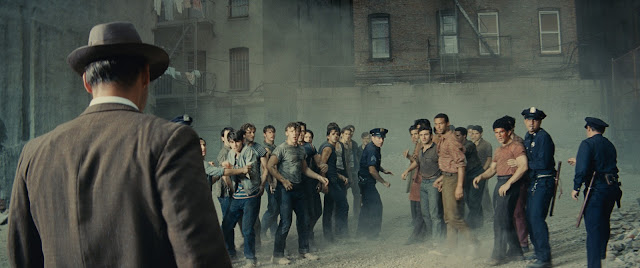
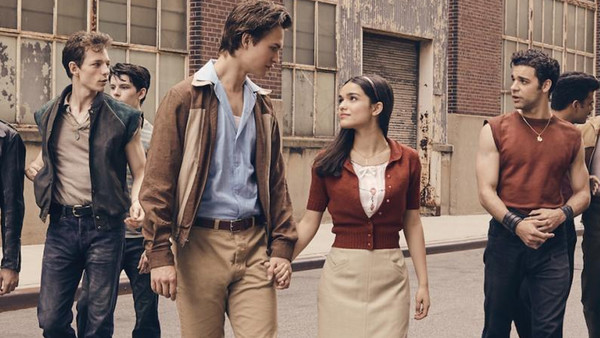
This broken setting makes the strife between the white Jets and the Puerto Rican Sharks, a tense and messy one, especially when the film moves into its powerful, shadowy final act. The adult world, especially its shambling law enforcement, is unable to heal the strife they are all complicit in creating. One exception is sympathetic and empathetic shopkeeper Valentina (Rita Moreno, Anita from the original film, in a moving performance and a wistful stroke of genius casting), who having been married to a white man, has been part of the Jets' lives since their childhoods, especially protagonist Tony (Ansel Elgort). This shopkeeper role is revitalized in this version, especially with Moreno's affecting portrayal. Still, as the two young lovers from different worlds, Tony and Maria (the angelic-voiced Rachel Zegler, in an impactful screen debut) dash off to make love, duet on fire escapes and behind bleachers, the discord between the gangs continues to enflame. 

West Side Story has inherently always been more from the white perspective--gang leader Riff (Mike Faist) and cohorts, including the misfit Anybodys (a memorable Iris Menas), are more textured characters compared to ringleader Bernardo (David Alvarez) and his Sharks; one exception that emerges in this version is Chino (Josh Andrés Rivera), who is given a richer presence that I've ever seen before, including a complex, believable arc. Much of the forward-moving action and early songs are driven by Tony and the Jets. However, it remains true that the most compelling character in West Side Story is Anita. With a committed fierceness, Ariana DeBose sails through this role with joyful, effortless-looking dancing and acting, melding her wide-eyed zestfulness with the grout of pain and tragedy. While clearly the cast standout, she doesn't annihilate her peers. In a "A Boy Like That," she lashes out until her and Zegler come to an incredibly moving plane of unity. 


In re-creating this late 50s New York, Spielberg's team of wizards--including Tony Kushner and his thoughtful script (as many have mentioned already--the addition of speaking in Spanish, without subtitles, is a very welcome one), pitches the musical in stirring set pieces. In the buoyant "I Feel Pretty," wedged within the story's most violent moments, the unknowing Maria takes a break from her after-hours cleaning job among her friends in a high-end department store, frolicking amongst bone-white mannequins, and swiping a silk scarf from a rack. In "Gee Officer Krupke!" the Jets are confined in a police station, twirling--with papers thrown and spun in midair--highlighting their uselessness in the face of larger social disarray. It's these kind of ironic dance scenes that make me eager to return to the film again, especially knowing how masterfully done the inevitable tragedies of the latter half are--what the film, and all its strands of characters are zooming towards. ***1/2


-Jeffery Berg

Wednesday, December 8, 2021

lucky

It's always enlivening to see filmmakers take on new approaches to genre, even if the results aren't entirely successful. Brea Grant (also the film's screenwriter) stars as May in Natasha Kermani's Lucky, where a violent masked stalker (Hunter C. Smith) repeatedly attacks May, breaking into her house. The time loop conceit in recent media like Russian Doll,  Happy Death Day and Palm Springs, has worn thin. Often these works think they are more clever than they actually are and one has to endure their purposefully irritating monotony. Comparably, Lucky is a more unremittingly sly and mysterious offering, even if not ultimately a particularly satisfying one. 

What Kermani and Grant are skewering is sometimes ambiguous in Lucky: is it the market-focused self-help books that one might find in the aisle of Target that the lead character writes (her new book, isn't doing well, and her career now feels tenuous)? One of the better crafted scenes of the movie, where May is at a loss for words at a book event, shows the inherent flimsiness of this type of advice writing when interacting with readers face-to-face. The film oozes with shades of blue--perhaps an oblique ridiculing of the gendered hue for baby boys; it's optically distracting sometimes (from clothing, to paint colors, to a pop of it in Dawn dish soap on the kitchen counter) and mismatching if it's in attempt to unite the film visually. Perhaps least compelling is the film's horror element, which quickly begins to wane thin as the film progresses, especially with its flat atmosphere. Those expecting a traditional scary movie from its promotional imagery will be premeditatively duped. As a movie about reversing the film trope of the woman being attacked by a creepy predatory man--the frustrations of dealing with law enforcement (both by men and women) and husbands (Ted, played by Dhruv Uday Singh, is maddeningly apathetic) in helping and taking women seriously--Lucky excels. Its title suggesting the trite pat on the back people give for a woman's mere survival. **

-Jeffery Berg 


Tuesday, December 7, 2021

drew's rainbow


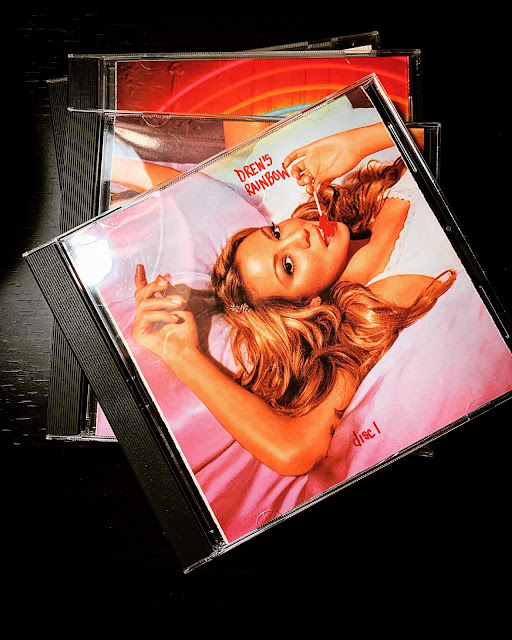
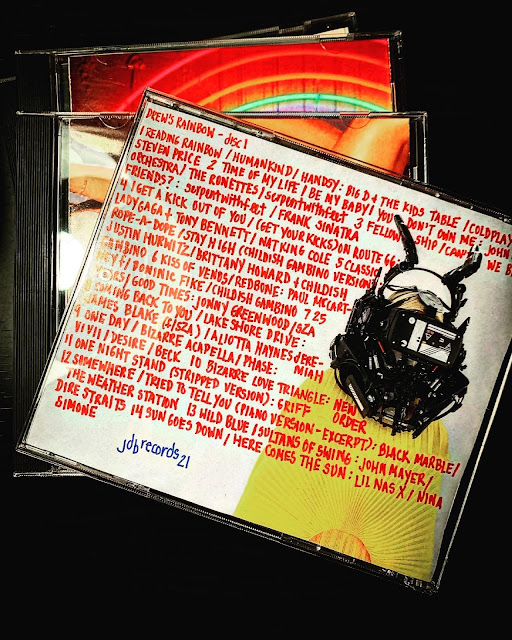
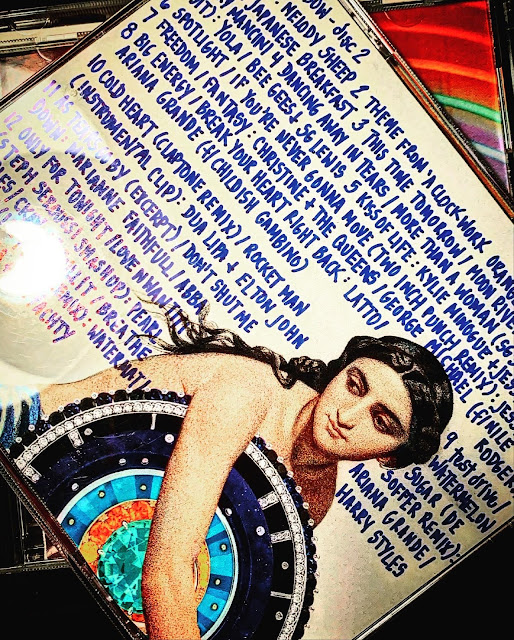
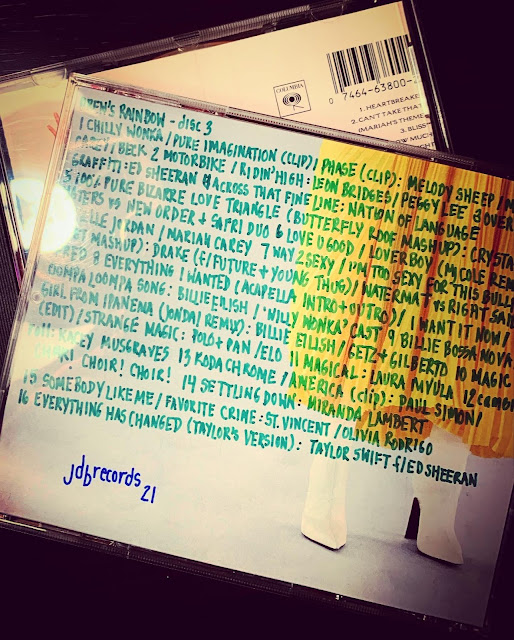
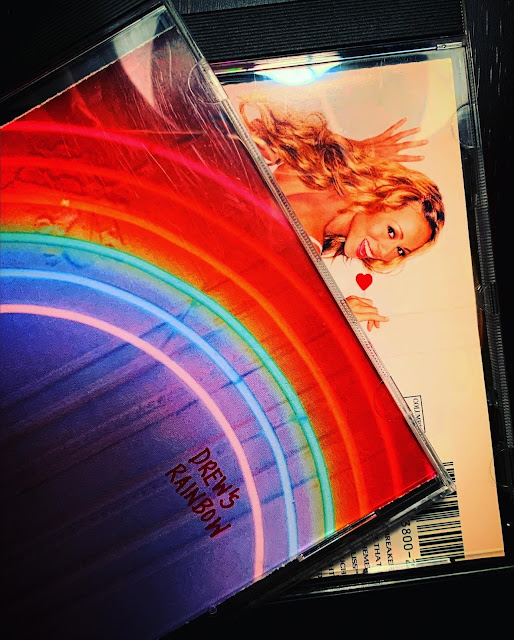
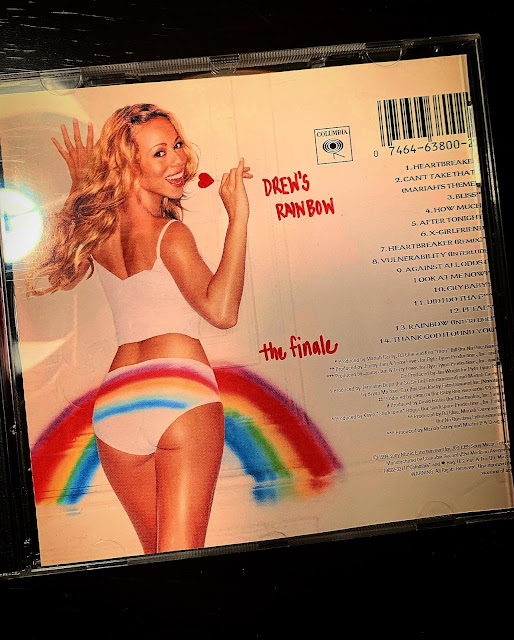
Recently I made a four disc set of CD's for my friend Drew entitled Drew's Rainbow.

I recycled a used copy of Mariah's Rainbow album for the artwork. 

Inspired by David LaChappelle's colorful photography, I went through songs with "rainbow" themes [including the "Reading Rainbow" Theme (which kicks off the odyssey) and a remix of Wizard of Oz dialogue by Melody Sheep]. 

While crafting the tracklists, my favorite discovery was a thrilling mashup of Crystal Waters and New Order on "100% Pure Bizarre Love Triangle" by Butterfly Roof.

I also found a nice through line with combining Drake's "Way2Sexy" and a mashup of Watermät's "Bullitt" and Right Said Fred's "I'm Too Sexy" in a medley. 


Monday, December 6, 2021

drive my car

The candy apple red Saab 900 in Ryûsuke Hamaguchi's Drive My Car blazes against the film's continuously washed-out color pallet. It's perhaps why that car, as it roams twisting highways, feels so significantly fixed in memory when thinking about the film. Hamaguchi's piece, influenced by works of Murakami (the movie is based upon stories from Men Without Women) and Chekhov, purposely and relentlessly restricts pleasure--its slick photography by Hidetoshi Shinomiya of modern drabness (neutral clothing, glinting yellow lights and white and grey concrete and wood walls and structures) is a dull thing to behold for its three hour runtime. It reminded me of the tones of the sleek German buildings in I'm Your Man or the white-ribbed World Trade Center Oculus: structures erected as an embrace of modernity, of living, and moving forward--especially over places of crisis, war and death--yet, their sterile, bone-colored somberness a tomb-like reminder of hallowed grounds. 

In Drive My Car, a significant part of the movie is set in Hiroshima, where a celebrated actor and writer, Yusuke Kafuku (Hidetoshi Nishijima), is mounting a production of Chekhov’s play Uncle Vanya. Afflicted with glaucoma, a symbolic gesture of blindness on the edge of what meets the eye, Yusuke must hire a driver to travel. Yusuke's quiet young chauffer Misaki Watari (Toko Miura, my favorite performance in the film), drives the red Saab, through womb-like tunnels and traffic-less roads, to what feels like the far reaches of the earth--to her hometown, her family and home, swept by landslides; nature, too, can bury over the past and the dead: viewing the crumpled wreckage of the house, it is half-buried by snow. This is an extremely moving aspect of Hamaguchi's richly layered film, and it's twinned with its literary sources. As we move along in the car, we hear the voice of Yusuke's departed wife, Oto (Reika Kirishima), as she reads lines from Chekhov on a cassette tape. Emotions too, are kept at bay. A sex scene of a woman screaming for pleasure is one shrouded to the audience in sadness, shame, and betrayal. Yusuke's bottled-up grief can be both a hinderance and asset to the direction of his play, especially with the casting of a young superstar lead actor, Takatsuki (Masaki Okada)--a perfect  contrast to Yusuke--with a past connection to Oto. 

While the film is well-played and shot, it's the unusual instance where the script (by Hamaguchi & Takamasa Oe) is more fascinating than the film itself. Something about those running rivers of language from the tape, to the halting dialogue in the table reads (its cast, often frustrated), to the storytelling between Oto and Yusuke and also, its arresting structure including a prelude, denouement, a coda that all have a lingering potency, all make me think of the blizzardlike wizardry of the script in contrast to the unabating austereness of the film itself. At three hours, visually, the movie is ponderous. The dramatic conclusions, including Yusuke's first emotional outpouring (the acting there, unfortunately, feels forced)--could work well on paper, or in a novel. Somehow, on celluloid, it renders empty and obvious after such a drab, winding run; surprisingly banal, for a film that seems to be up to something more complicated and mysterious. Still, the ambition of the movie and the blending of its literary influences, cannot be ignored. The note of hope the film ends on, that candy red car in a lot of white and silver vehicles, is likely a stirring one for the viewer. ***


-Jeffery Berg 

Thursday, December 2, 2021

Wednesday, December 1, 2021

the power of the dog

In an era where the ideal of "strength" relentlessly persists within the confines of aggressiveness, muscularity and machismo, The Power of the Dog completely upends it in Jane Campion's quietly stirring revisionist western (based upon a novel by Thomas Savage). It's another vibrant, illuminating film in Campion's oeuvre; her fiercely intelligent period pieces such as An Angel at My TableBright Star, The Piano, and Portrait of a Lady, are always slightly askew from expectations and conventions. This tale set in dusty 1925 Montana feels much more bracing, fresh and subversive than many contemporary movies--and its all captured skillfully and unassumingly. 

Benedict Cumberbatch's vociferous rancher Phil is an aching mess of a character to behold--his hidden queerness gnawing him up inside and out. We watch the sensuality of him buffering a saddle of the departed Bronco Henry; and crawl through the trunks of trees to a clearing and a small lake where he luxuriates after slathering himself in mud--a place where him and Bronco Henry once shared. There are many heavy, literary metaphors like this in The Power of the Dog, but yet, not so heavy that they sink the movie. Instead, they enrich the picture--its tensions and mysteries building throughout. Phil is living in the same house as his brother George (Jesse Plemons, in another finely-tuned character turn) and George's former innkeeper wife Rose (Kirsten Dunst) and her son Peter (Kodi Smit-McPhee), who visits when not in medical school. Phil and George are wealthy ranch owners: Phil lives a doggedly grubby cowboy existence while George, to Phil's disdain, dresses and lives in a conservatively posh manner. Their relationship feels tenuous from the beginning, when Phil refers to him (and inherently, his lifestyle) as "Fatso." Rose and Peter, who Phil contemptuously describes as "a suicide widow and her half-cooked son," are suddenly wound within Phil's taunts and broody, agitated loneliness. A competition of companionship almost emerges within all of these characters from the throes of Phil. When Rose haltingly plays the "Thunder and Lightning Waltz" by Johann Strauss Jr. on the grand piano George gifted her, Phil one-ups her upstairs in the stairwell with a virtuosic take of the tune on his banjo; later, he taunts her, hidden from view, from an open window, whistling its melody. Phil is all thunder and lightning indeed in this quartet. Cumberbatch's embodiment is so red-blooded and alive, the viewer can sense everything that's going to make him tick, as one readies for what he is going to inflict next upon the others. He bullies Peter at first (him and the fellow cowhands are brutal), but slowly Phil becomes flummoxed by him and closer to him--almost emulating Bronco Henry ("He taught me to use my eyes in ways that other people can't") and the dynamic between him and himself when he was Peter's age. Any attraction he may have to Peter is  impossibly buried. As Peter, the lanky, rail thin Smit-McPhee, gives a haunting portrayal--his serenity and intellect a vigorous match against Phil. Kirsten Dunst is eerily captivating as Rose, as we watch her downward spiral into alcoholism. Despite their modest lives, none of the characters of this tale ever seem comfortable with themselves, especially when someone so loveless is taking up all the air in this ever-chilly house. 

As expected of any Campion film, the crafts are top-notch. Jonny Greenwood's tremulous, rugged string score adds to the anxiety, as it did in his masterful work on Spencer this year.  I was taken by Ari Wegner's photography (who also shot this year's bold-looking Zola). Campion has always been a director with a sense of the rigorous physicality of nature, rather than just ornamental pretty shots. The streams of herded cattle, blood-flecked wheat, the dusk skies--clouds edged with faded sunlight--the plains and far off mountain ranges like a wounded, muscled back and the roaming harsh, hardened ridges of Phil's closed-up heart. ***1/2


-Jeffery Berg


keep movin'!

Dave Lee provides a rousing remix of one of my favorite singles of the year, Jungle's "Keep Moving."


Music video for the original track below. Directed by J Lloyd & Charlie Di Placido and Choreographed by Nathaniel Williams & Cece Nama.