Meep and I made it to the end of 1992! It was so fun revisiting the films of this year on the Retro Movie Love podcast. Lots of variety, and some overlapping themes.
YouTube of our discussion below:
Meep and I made it to the end of 1992! It was so fun revisiting the films of this year on the Retro Movie Love podcast. Lots of variety, and some overlapping themes.
YouTube of our discussion below:
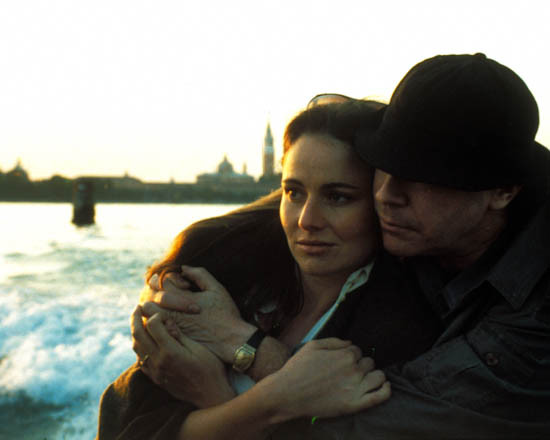
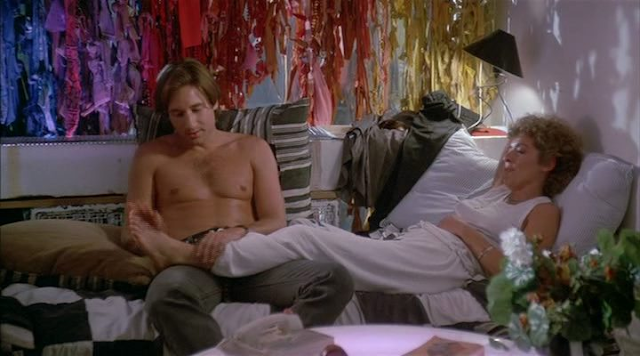
In 1992's Venice/Venice, Jaglom plays a director named Dean, who is at the Venice film festival for the only American picture in competition. Venice/Venice was actually filmed during the 1989 fest in which Jaglom's New Year's Day screened. The young David Duchovny is the star of that film, and also appears here, as an insecure, restless sun-tanning actor, who seems to be aiming for something greater. It's interesting to watch him in retrospect as he later becomes such a famed celebrity and even the titular subject of a pop song. As with Jaglom's other movies, the craft and hierarchies of art, performance, vanity and commerce gets a sort of gentle drubbing. As Jaglom's Dean gives terse, cranky interviews for the press, the alluring Jeanne (Nelly Alard) watches admirably and works up the nerve to talk to him. Of course Dean is attracted to Jeanne (just noticing the similarities in their names now); if Jeanne is attracted to Dean, it's not entirely clear why. Is she so enamored by his films? He isn't attractive so to speak, nor does he seem to be much fun to be around. But there is a push and pull between them--a dynamic--that Jeanne, with her sensuality, wit and sharpness, fosters. It's sort of a compelling romance to watch in its unnerving oddness.
When the film flips to the vibrant "other Venice" in California (where we see a time capsule of Venice Beach as it was; even one of that summer's ubiquitous Batman logos appears), we are introduced to Dean's lover, Peggy (Melissa Leo). Since her earliest roles, one can see how completely (almost scarily so) committed Leo is to her craft. It is what continues to make her such an exciting actress to watch. Here, with her shaggy golden curls and emotionally open face, she's in such stark contrast to Jeanne's dark sleek hair and air of effortless, sunglasses perched on crown, French posh-ness. But the contrast doesn't fester into a typical combative element between the two women. Instead, Leo delivers a bravura, complicated performance that's a mixture of receptiveness, sympathy, trepidation, and hurt. It creates an engaging connection between the two characters and actors.
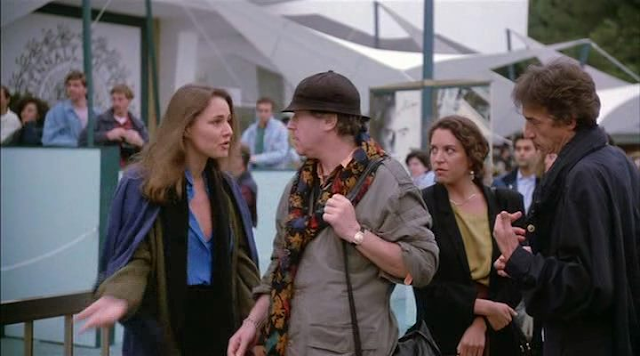
Interspersed throughout this tiny drama are testimonies from women (supposedly all acquaintances of Jaglom) about old movies, romance, and love. Their declarations are sort of cliched and basic desires and wants that they now seem jaded about--nothing comes off as particularly surprising. But the women, staring directly into the camera, in front of a window frame painted puce-pink to match its puce-pink blinds, with their on-the-brink-of-the-1990s styled hair, make-up, and clothing, are a haunting chorus throughout. The movie itself also plays with perception--at one point a table of the actors looks directly at us, in coy proclamation of the falsities of film. The editing feels purposefully rough-hewn and off (are the eyelines matching? does it matter?). Later, there's a pretty amusingly self-indulgent sequence where Dean has a bunch of actresses "audition" as a group for a role to play his wife. The gall, the nerve of him (!), and the perversity of watching these actresses unload. Physics, something that Jeanne has studied, comes into play as a means of locales, chance, and existence. This is a gem of a film, with striking performances, and lots and lots of smartish talking--in that rhythmic, off-the-cuff way that can be so beguiling, well... at least for myself. ***
-Jeffery Berg

Meep & I were missing '92 so came back to take on the array of films released between July and September of that year.

Some highlights: Gas Food Lodging, Boomerang, Husbands and Wives, Sneakers, Singles & Single White Female... and Mikey!


The 1992 series of the Retro Movie Love Podcast rolls on with films released in May & June.

Some highlights include neo-noir One False Move, cab ride anthology pic Night on Earth, eerie The Adjuster, direct-to-TV Illicit Behavior, Batman Returns (especially for its crafts), the charming HouseSitter, and the loveable hit Sister Act.

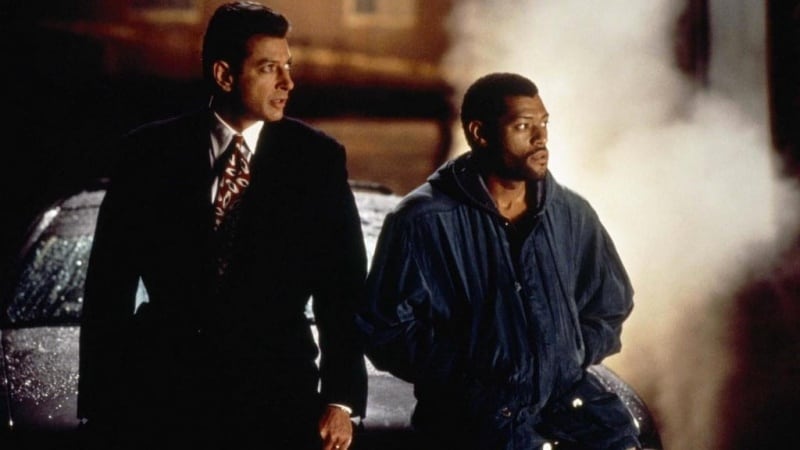


I joined Meep (Michael Ferrari) again for his Retro Movie Love Podcast on films from 1992! We started at the very beginning with the theatrical release calendars for January & February '92.

Juice and the rollicking The Hand That Rocks the Cradle were clear standouts. I also enjoyed Where Angels Fear to Tread, a lesser known E.M. Forster adaptation from the same year, but still an intricate and compelling story and film.

Also check my reviews of two overlooked gems here: Paper Mask & Under Suspicion.

Podcast links include:

If I wanted to steal someone's identity and profession, a physician / surgeon would absolutely not be on my list. But in Christopher Morahan's eerily unsettling adaptation of John Collee's publishing-dubbed "medical thriller," Paper Mask, that's exactly what the main protagonist schemes his way into and signs up for. Matthew Harris (Paul McGann of 8th Dr. Who renown) plays a lowly porter in a London hospital. After witnessing a car crash outside of a pub, Harris steals the identity of the victim--Simon Hennessey (Dale Rapley)--a doctor at his hospital. The movie moves swiftly through its crackerjack plot as Harris lands a residency at a hospital in Bristol, much to the chagrin of one of its board members (a delightful Tom Wilkinson). Harris, while having a modicum understanding of medicine, teams up with nurse Christine Taylor (Amanda Donohoe), who helps him as far as she can with the occasionally stomach-churning medical mishaps that arise. A romance soon develops between Matthew and Christine, and their symbiotic vibe is both surprising and morally askew.

In most stolen-identity thrillers, we usually luxuriate in something flashy and glamourous, not wonkish, life-or-death, stress-inducing states. So maybe that's why as an audience member, I wasn't hoping for Harris to "get away with it." Among the tradition of Highsmith-inspired cinema, while not as sensuous and sweeping as Anthony Minghella's The Talented Mr. Ripley nor as pulpy and devilishly fun as the film versions of Ira Levin's A Kiss Before Dying, Paper Mask is a chilly, straightforward yarn of human perversity. It also shows how far someone without qualifications (or with the "guise" of qualifications) can advance merely by being a sociopathic man. Additionally, the film touches upon how power structures inevitably protect the powerful. The combination of Nat Crosby's dullish-hued cinematography and McGann's plain, unembellished performance (though he goes for a bit of ham singing out The Platters' "The Great Pretender"--an obvious musical motif throughout the movie) adds to the clinical queasiness of the tale. As Harris's foe, Wilkinson injects the movie with bite. ***
-Jeffery Berg
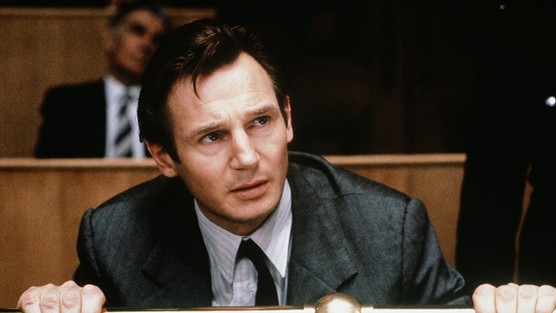
For those who enjoy Liam Neeson in hammy, melodramatic avenging mode, Simon Moore's (writer of Traffik) 1991 noir Under Suspicion, may be a let-down. It's not posh, prestigious, or tidy enough for anglophile mystery folks either. Instead, Moore's movie, mostly set in stuffy, repressed 1959 England, is sort of a dreamy, twisty erotic crime story--red-splattered and gory as the valuable paintings evoked in the film. The movie didn't make much of an impression on audiences nor critics when released, but it remains an entertaining little flick.
Neeson stars as Tony Aaron, a rouge photographer and private eye, who sets up shots of philandering spouses in bed with other people, sometimes even using his own wife (Maggie O'Neill). The film clearly lays out Tony's work in the main title cards: in 50s England, it was practice to have these paid set-ups of faux affairs to circumvent strict divorce laws of the time. After a tragic mishap, Aaron becomes ensnarled in the life of a wealthy woman Angeline (Laura San Giacomo) who is also a wife of a recently murdered painter.
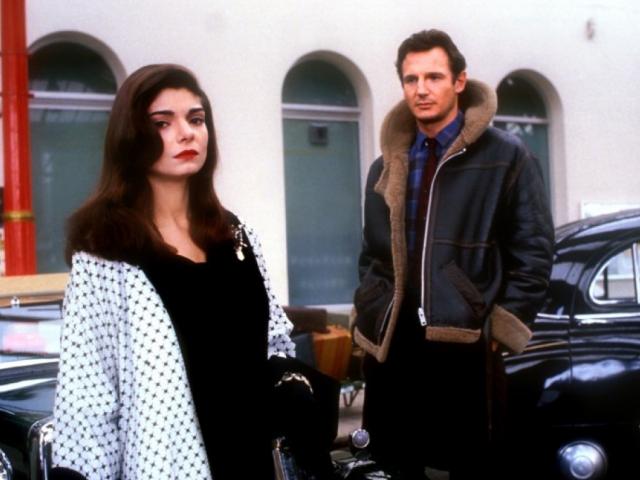
Under Suspicion thrives on a plot of thorny twists and its economical editing (by Tariq Anwar--who would later work on a number of prestige pictures throughout the 1990s and into the 2000s, including American Beauty, The King's Speech, and recently One Night in Miami...). One can see Anwar's gift in shaping a quick-to-the-point feature here, including an impressive, if amusingly overheated, race to the gallows sequence. Despite its trimness, Moore's movie and Vernon Layton's cinematography captures an overcast England mood and devilish intrigue. Also notable is Christopher Gunning's throbbing score.
Neeson is particularly sexy in this role, acting with notes of bravado (and occasionally, into the overwrought). As Angeline, Giacomo is alluring and mysterious, dressed (by costumer Penny Rose) in cool, chic black hats and dresses--the kind of costumes Edith Head might have designed for Grace Kelly in a Hitchcock movie. Perhaps purposefully, Angeline feels out-of-place; Giacomo has always felt more like a contemporary performer than a period piece performer--a certain rawness that seeps through her demeanor. Nevertheless, this adds to the opaqueness of Angeline and the story's main mysteries. A sturdy supporting cast abounds including Kenneth Cranham and a transfixing Alphonsia Emmanuel. Overall, I found this lean, carnal mystery, with its nostalgic early-90s veneer, a nice diversion and a treat in an era of bloated series and films. Under Suspicion is currently available on Blu-Ray from Image Entertainment. ***
-Jeffery Berg


