Thursday, September 6, 2012

flight of the navigator - a post by rebecca myers


Dan and I were glamping in the Italian Countryside outside of Venice when he admitted that he'd never seen Flight of the Navigator. Lounging on a Balinese pashmina spread out on the floor of our tented lodge, eating baby octopus with our hands, naked, it occurred to me that I might not actually know my new husband.

"Ha ha, seriously, hehehe?" I asked in my best Pee-Wee Herman voice, a tentacle dangling from my mouth.

"Seriously."

One of the benefits of luxury camping is having wireless internet. Dan and I had been on our honeymoon for 8 days and had already capitalized heavily on the romance thing. So I decided, amidst the muted evening bells of San Marco and tulle mosquito netting, that we needed to download this sci-fi classic.

In grade school in the late 80's, Flight of the Navigator was shown as a special treat. It was one of the few movies on free period rotation, along with Million Dollar Duck, The Shaggy Dog, and Freaky Friday. My first real impression of cinema was that it only dealt with shape-shifting and divested identity. I had a very real fear that one morning I would wake up and no longer recognize myself. This was further complicated by my not recognizing myself to begin with.

Disney movies were ontologically dark. You might be accidentally irradiated, or start to remember you are an extraterrestrial (it's never a good sign if you own a star case with an indecipherable map in it). If you had to have special powers, it was preferable that they were temporary. You prayed that whatever transformation you underwent didn't have lasting effects, that the Watcher would return you in a pillar of light, or that you'd wake up in a ravine and it would still be 1978.

As a 9 year old, Flight of the Navigator made me feel very out of control. The film is ostensibly about appreciating your family and developing self-confidence, but my take-away was a great foreboding, a sensation that time was collapsing around me, all at once, like a giant chocolate segmented orange.


In the film, David Freeman, a 12 year old with aspirations of entering his dog in a National Frisbee Championship, is knocked unconscious in the woods on the way to collect his brother from a friend's house. When he awakens, he discovers it's 7 years later -- 1986 -- but that he hasn't aged. David's arrival in the present- day future coincides with NASA's discovery of a spaceship. With the help of family, scientists, and Sarah Jessica Parker, David learns he was abducted by an alien craft collecting specimens from various planets on behalf of his home planet, Phaelon.

The spaceship -- named Max, and voiced by Paul Rubens -- explains that he needs David in order to return home. He lost access to star charts when he crashed into an electrical tower, but these star charts remain intact inside of David's unerased brain. Max apologetically reveals that traveling at the speed of light was what resulted in the discrepancy in time: they were only gone for hours, while years passed on Earth. David permits Max to scan his brain despite the risk of death, and Max winds up with not only directions, but human attributes. Scuzz-bucket, Twinkies, two all beef patties special sauce, Twisted Sister, New Coke, Classic Coke: all become part of Max's lexicon. As David and Max elude government capture, Max takes navigational command, harnessing a self-assurance he didn't know he had. He literally finds his drive. The ending -- David brought back on Fourth of July, 1978, boating beneath fireworks -- is like a tribute to American family values.


"Well, what did you think?" I asked Dan. The church bells had turned into pulsing Italian techno.

"I like it. Although, NASA's computer systems didn't make any sense. They shifted from textual to pictorial displays. Relativity was off too -- David would have been gone for much longer. Hmm. Unless Max traveled by wormhole. Also, wouldn't  the military have had jurisdiction over an alien ship?"

This is my husband: troubled by bad technology and quantum anomalies. Me, I spent most of fifth grade (and subsequent years) terrified of decade displacement, of the world around me accelerating beyond my ability to keep up. This is really at the heart of being a kid. It's an eternity between birthdays, and yet important change happens so quickly. You define yourself in relation to others but those others aren't fixed points on a graph. You outgrow your shirts in one season. Your grandmother dies while you're at an ice-skating party. The Challenger explodes one week, you're watching Flight of the Navigator the next.

Shortly after we returned from our honeymoon, I read that a tourist in Iceland had joined a search party to track down a missing member of her bus group. The missing woman was described as wearing dark clothing. She was last seen in Eldja’s volcanic region. After hours of looking, with the coast guard at the ready, the tourist had a demoralizing realization: the missing woman was herself.  She had changed clothes and freshened up during a pit stop, and when reported gone, simply failed to recognize her own description. While this is an extreme example of the self proving elusive, I know exactly how this woman felt: the psychic disjunction, the humiliation, the faltering of faith and certitude. It's how I  felt at age 9. It's how I often feel today. What scared me most about Flight of the Navigator is that David ultimately walks away a securer, happier person despite witnessing the search for his former self. He's redeposited back in 1978 no worse for the wear. The only baggage he appears to have is Puckmaren, a stow-away alien who likes to have his chin scratched. But David's seen so much. He's been the universe's pawn. How can he peer through the same bedroom telescope and not see an esoteric mess reflected?

There are days I look at Dan and think: "I'm the same person I was 5 years ago, but he's so different." Those are the days that I'm still stuck in 1978 while he's progressing in his parachute pants. But like in all solid relationships, it flips. Sometimes I'm the one wearing the parachute pants. Flight of the Navigator might not hold up against 21st century CGI, but to me, it remains timeless in its treatment of time, in its ability to tug at my neuroses.


Rebecca Myers is an essayist & poet & travel agent.  Check out her smart and funny blog From Soho to Silo.

Wednesday, September 5, 2012

some tongue-in-cheek 80s gems from karen g.


Gone and probably forgotten…Karen G. takes a look at some lesser known 1980s movies


Invaders from Mars (1986)


Tobe Hooper’s remake of the 1950s Sci-Fi classic stars Karen Black, Timothy Bottoms and Hunter Carson who plays the heroic young boy who tries to save his town as aliens begin to take over the minds of his parents and every other grown up in sight!  (Carson happens to be the real-life son of Karen Black).


The Garbage Pail Kids Movie (1987)


I read recently that some of your old Garbage Pail Kids cards could be worth upwards of $4000 thanks to runaway ‘80s nostalgia that has taken the world by storm!  Sadly, the only Garbage Pail Kid memorabilia I have in my collection is the movie.  According to this charming flick, even if you’re really disgusting, a great personality goes a long way! 


Witchboard (1986)


What do you do when someone tells you NOT to use a Ouija board when you’re alone? Well, you use it alone of course, and it’s all fun and games until you unleash an angry spirit!


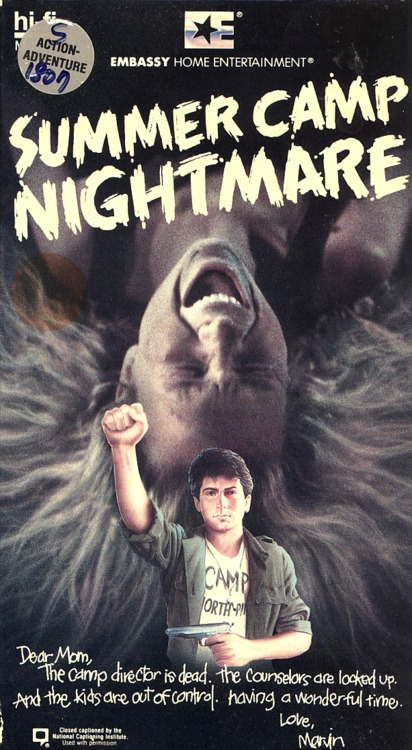
Summer Camp Nightmare (1987)


Dare I say that the title says it all?  This movie is Lord of the Flies meets Sleepaway Camp.


The Legend of Billie Jean (1985)


Just because you’re a cute blonde, does not mean you’re not a bad ass.  This is what happens when you push a woman too far!  P.S. Helen Slater – where are you girl?


Baby: Secret of the Lost Legend (1985)


A long time ago, in a galaxy far away, before CGI, After Effects and Photoshop…movie makers lived in a world of stop-action animation and a little something called “Animatronics”.  If you’d like to see both of these things done particularly badly, please check out this heartwarming movie.


Masters of the Universe (1987)


Dolph Lundgren as Russian boxer Ivan Drago in 1985’s Rocky IV may have been one of the most terrifying characters of my childhood.  He then later transformed into superhero HE-MAN in 1987 and won me over again!  (All this aside, Frank Langella played "Skeletor," how bad-ass is that?)


Maximum Overdrive (1986)


I’m convinced that Stephen King can make anything scary.  This is what happens when bad machines happen to good people (like Emilio Estevez).


Shocker (1989)


"Just when you thought sending him to the electric chair would be the end of him."  Wes Craven does it again in this campy horror.


Hider in the House (1989)


If I ever saw Gary Busey staring in my window you better believe I would run like hell…no questions asked.


Saturday the 14th (1981) 


Pranks and Monsters lurk in every corner in this fun “fantasy horror” by Howard Cohen.


Q (1982)


What do you do when you hear reports about a giant killer lizard flying around New York City?  Move to California.

Tuesday, September 4, 2012

barack the vote


"Barack knows the American Dream because he’s lived it, and he wants everyone in this country to have the same opportunity, no matter who we are, or where we’re from, or what we look like, or who we love."

"And if so many brave men and women could wear our country’s uniform and sacrifice their lives for our most fundamental rights…then surely we can do our part as citizens of this great democracy to exercise those rights…surely, we can get to the polls and make our voices heard on Election Day."

"If farmers and blacksmiths could win independence from an empire…if immigrants could leave behind everything they knew for a better life on our shores…if women could be dragged to jail for seeking the vote…if a generation could defeat a depression, and define greatness for all time…if a young preacher could lift us to the mountaintop with his righteous dream…and if proud Americans can be who they are and boldly stand at the altar with who they love…then surely, surely we can give everyone in this country a fair chance at that great American Dream."

-Michelle Obama

Full speech here.


madonna in the 80s


Monday, September 3, 2012

the safecracker


The 1981 crime thriller Thief  is rather unremarkable plot and script-wise but is notable for its influential style on neo-noirs (including last year's Drive... just look no further than comparing the font for the title of each film on their respective posters) and for being director Michael Mann's debut.  Mann would later be known as an auteur of classy crime pictures such as Heat, The Insider and Collateral.  In Thief, you can see what would later be trademarks of Mann's work: night scenes with bluish, shadowy lighting and flawed male antiheroes trying to work themselves out of corrupt systems.  James Caan plays Frank, a professional safecracker and ex-convict with dreams of settling into a normal life.  After one of his co-horts is killed, he is soon involved with the mafia, working for Chicago Outfit boss Leo (a sinister Robert Prosky). Meanwhile Frank tries to appeal to his girlfriend (Tuesday Weld) by wanting to start a family.

The good cast (including a convincing appearance by Willie Nelson as Frank's old friend from prison) and Mann's stylistic concerns (including the moody synth soundscape by Tangerine Dream) make Thief  an above-average mob movie, even if you feel you've seen it before. Thief is filmed with a gloomy elegance by Donald E. Thorin.  There's good tension in the pic too; Mann has a way of making things uneasy in the quietness (the final showdown is pretty great).  Besides the neon beer sign-lit streets, close-ups of guns and authentic safecracking materials, there are some great moments which utilize POV and a feel for character, notably a shot with Prosky menacingly looking down on us.   ***

Sunday, September 2, 2012

the latter days


"... I'm filming my life in order to have a life to film like some primitive organism that somehow nourishes itself by devouring itself -- growing as it diminishes..."

Director Ross McElwee's Sherman's March: A Meditation on the Possibility of Romantic Love In the South During an Era of Nuclear Weapons Proliferation is a sprawling cinéma vérité and a unique personal odyssey.  It begins in a barren loft apartment, white light through the windows, with a calm, whispery and laconic voice-over.  North Carolina-bred McElwee tells us he had intentions of making a documentary about the Union General's Civil War "March to the Sea." Besides the grandiosity of Sherman's campaign, McElwee is also fascinated by Sherman's paradoxical nature: how did one who had come to love the South end up ultimately destroying it?  Yet the idea for his doc is dashed when McElwee finds himself in deep grief after recently being left by his girlfriend.  McElwee soon returns home to North Carolina, and begins thinking about the women in his life. He first meets up with Patricia, a free-spirit who defies the conventions of her upbringing by trying to make a break as an actress. McElwee films her with a Woody Allen-idiosyncratic lust as she does her "cellulite exercises."  Like many of the women in this film, Pat goes off to pursue someone or something else and soon we almost miss her in the way that McElwee does.  His rambling trek follows some of the regions Sherman had destroyed with his 'scorched earth' methods.  Armed with his camera, he meets up with isolationists (they rail against the government intervention but praise nuclear proliferation), plutonium protesters, and even a wannabe Burt Reynolds body double (Reynolds is filming Stroker Ace in North Carolina and around Georgia -- one of Pat's dashed dreams as a potential co-star and a cause for some excitement for the locals).  The women he presents to us are his source of love, admiration, desire and also his agony.  He's often sleepless, thinking about his personal failures and nuclear war (it was filmed in the early 80s, a few years before its 1986 release).  


With its lack of phoniness and judgement, its frayed edges (sometimes the picture or the audio goes out) and revealing moments, Sherman's March is a stunning American portrait.  It's a bit long, but is so full of compelling and wistful scenes: a coming storm over an isolated Georgia island, an aspiring singer (Joyous Perrin) belting out "Respect" in a Sears parking lot, Pat's convoluted and brilliantly strange idea for a movie, potential love-mate Dee Dee's performance of "Just the Way You Are" for an all-girl's school ("the cradle of Southern womanhood") and her subsequent description of her Mormonism.  McElwee has a quiet nature that seems to cause these women to open up to him in unexpected ways.  I was reminded of some of the quote I posted yesterday by Darian Leader describing Robocop: "...he is no longer just a male biological body: he is a body plus machinery."  The camera is a powerful, sexual piece of machinery in this film, as it captures the spirit of and McElwee's carnality for these women.  And perhaps his subjects divulge so much because they know they are on camera (an ecstatic crowd wanting to glimpse Burt Reynolds becomes a self-reflexive scene).  McElwee knowingly stretches some of Sherman's legend and mythology into his own personal strife even when it seems trite. His first person account is perhaps landmark and familiar to us now with such a bevy of quirky docs and reality television but because of its heart and unbridled nature, the film remains an engaging chronicle.  ***1/2

-Jeffery Berg

Saturday, September 1, 2012

the future has a silver lining


With its specific 1980s Cold War allegorical bent (but yet still relevant today), Dutch filmmaker Paul Verhoeven's sci-fi romp Robocop remains a startling send-up of American violence, media and corporate corruption.  It's startling mainly because of its format -- nosiy, boyish blockbuster -- and like most complex film satires, it embraces what it mocks (violence and non-subtlety).  An enterprise, Omni Consumer Products, plans to gentrify crime-plagued "Old Detroit" and metamorphose it into "Detla City." After a droid ("the future of law enforcement" / "hot military product") malfunctions in a board meeting, in the movie's first big shootout (filled with chunky gore), a dead cop Murphy (Peter Weller) is revamped into Robocop, a gun-toting cyborg created to rid the city of its crime and relieve the burden of an overtaxed police unit once and for all.  In the presence of his former partner Anne Lewis (Nancy Allen), Robocop/Murphy begins to remember his former self and gathers information to hunt down his killer and also his mercenary megacorp creator.

Robocop is rife with in-jokes and black comedy.  It opens with a TV-viewer POV scene of newscasters with warm smiles relaying dire events of the world (the prescene of Leeza Gibbons reminded me of the Don Henley "Dirty Laundry" lyric: "she can tell you about the plane crash / with a gleam in her eye") and a creepy commercial pitching corporate-owned artificial hearts. The brilliance of these two TV set pieces establishes the tongue-in-cheek, unsettling mood of the film and its thematic motifs: the inharmonious coexistence of humans and also human (and masculinity) and machine ("the silver lining").  It's a bleak movie but it's also a lot of fun to watch, as it moves quick from one scene to the next, smoothly edited by Frank J. Urioste, who earned an Academy Award nomination, and energetically filmed by Jost Vocano, with its tracking shots and menacing low-camera angles.  There are impressive moments inter-laden in Robocop's static-laced TV-vision, especially when he travels back to Primrose Lane and recalls his family (his son watches a violent 'TJ Lazer' cop show on television) while stalking the barren rooms of the mod-1980s house, with its glossy black fireplace, cold white walls and detritus (a broken 'World's Best Husband cup' in the kitchen and photos with burned edges--likely destroyed by Murphy's wife in grief).  As the real estate agent (a head in a boob tube) extols the house's virtues, the scene moves seamlessly through flashback and present.  In the flashbacks,  the performers of the son and wife deliver an eerie, heightened commercial-style of acting.  I distinctly remember this style from the overload of relentlessly chipper 80s ads I saw as a kid; in the movie, Verhoeven spoofs this and war-culture in his commercial for the family board game "Nukem."


It's a man's world in Robocop and nearly all the men in the film are schemers and villians (Clarence played with cartoonish menace by Kurtwood Smith is the creepiest).  Allen, as the tough, gum-popping partner, is one of the film's few female characters, and is refreshingly non-romanticized, and also the most humanistic.  British psychoanalysis Darian Leader describes the movie as a study in man and machine: "his son always insists, before the transformation, that his human father perform the gun spinning trick he sees on TV. When the robot can finally do this properly, he is no longer just a male biological body: he is a body plus machinery, a body which includes within it the symbolic circuitry of science. Old heroes had bits of metal outside them (knights), but modern heroes have bits of metal inside them. To be a man today thus involves this kind of real incorporation of symbolic properties."  When Robocop uncovers his helmet and sees his face within a broken piece of mirror, we see the "metal inside" him and the movie itself. The film is dependent on male-infused violence to be entertaining for its intended audience.  Originally it was rated 'X' but then cut down and was a subsequent box office success in 1987. The yuppie boardrooms in sleek glass towers seem to me  an ironic statement not just on 1980s corporate culture but also Hollywood. I was reminded, too, how a movie is simply, like Robocop himself, "a product" but a product full of interesting paradoxes and themes.  ***